

SEO Meta Title: Allis Tissue Forceps: Uses, Types and Features
Meta Description: Learn about Allis Tissue Forceps, their uses, features, sizes, benefits, cleaning, maintenance, and tips for choosing quality surgical forceps.
Focus Keyword: Allis Tissue Forceps
URL Slug: allis-tissue-forceps
Introduction
Allis Tissue Forceps are common surgical instruments. Surgeons use them to hold and grasp tissue during many procedures. They offer a firm grip because they have small teeth at the tip.
Good tissue control is important during surgery. Therefore, surgeons need an instrument that can hold tissue in place. Allis forceps can provide this control when used on suitable tissue.
In addition, these forceps have a locking system. This system keeps the jaws closed without constant hand pressure. As a result, the surgeon can maintain a stable grip.
Most reusable Allis forceps are made from stainless steel. They are also available in several sizes. Therefore, hospitals can select the right model for each procedure.
This guide explains the uses, features, sizes, benefits, and care of Allis Tissue Forceps. It also explains what buyers should check before ordering them.
What Are Allis Tissue Forceps?
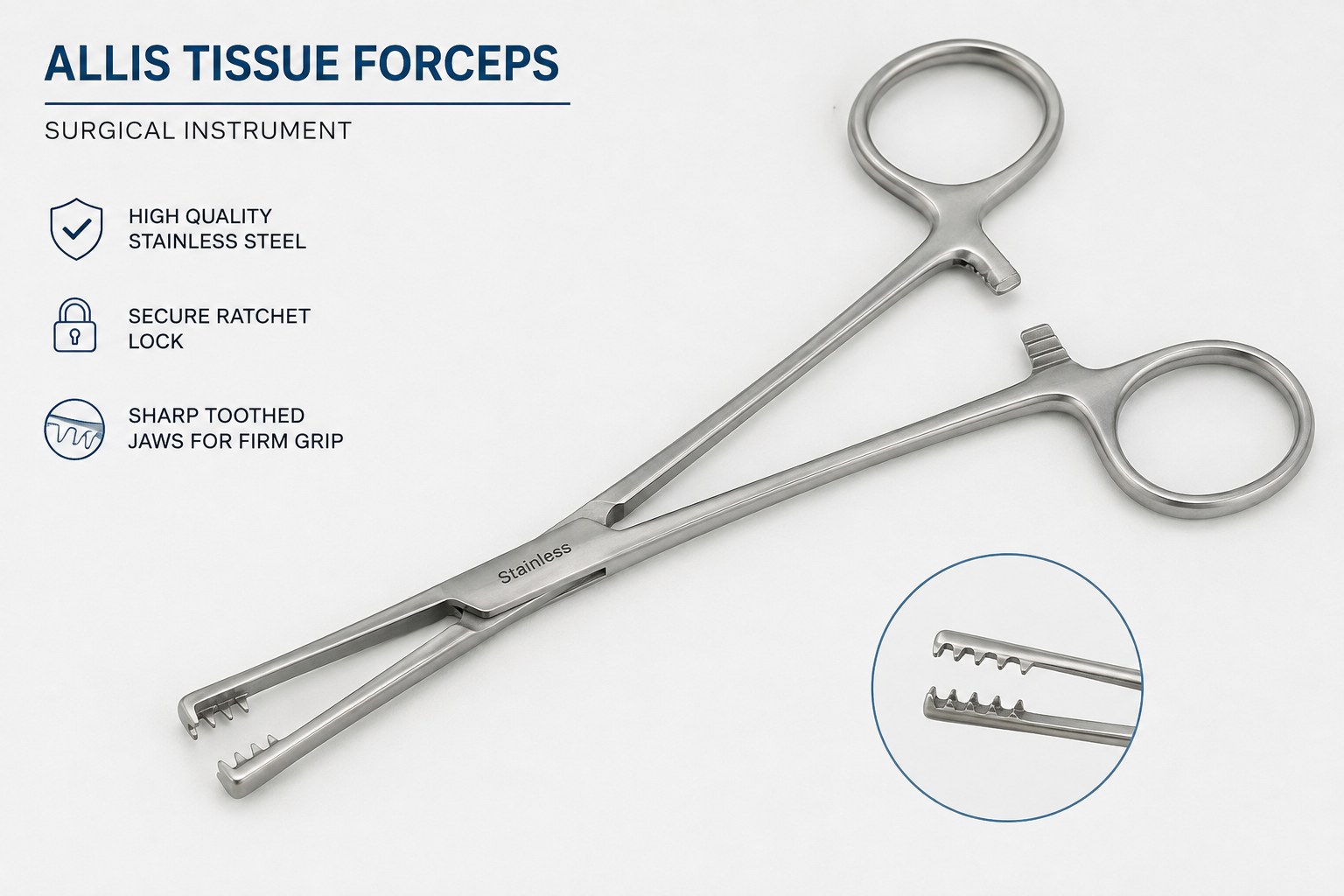
Allis Tissue Forceps are surgical tools used for tissue handling. They have finger-ring handles, long shanks, a locking ratchet, and toothed jaws.
The toothed tip is an important feature. It helps the instrument hold tissue firmly. Therefore, the tissue is less likely to slip from the jaws.
The handles are easy to control. When the surgeon presses them together, the jaws close. At the same time, the ratchet can lock the instrument.
As a result, the forceps can continue holding tissue without constant pressure from the hand.
However, Allis forceps have a strong grip. For this reason, surgeons must select them carefully. Delicate tissue may require a gentler instrument.
Main Features of Allis Tissue Forceps
Allis forceps have a simple but useful design. Each part has a specific purpose.
1. Toothed Jaws
First, the jaws contain small teeth. These teeth help hold tissue securely.
The teeth also reduce unwanted slipping. Therefore, the surgeon can maintain better control during the procedure.
Different tooth patterns may be available. The exact design depends on the model and manufacturer.
2. Finger-Ring Handles
Allis forceps normally have two finger rings. These rings allow easy opening and closing.
In addition, the ring design gives the user better control. This feature is common in many surgical clamps and forceps.
3. Ratchet Lock
A ratchet is located near the handles. It locks the instrument after the jaws close.
Therefore, the surgeon does not need to keep squeezing the handles. The ratchet maintains the selected position.
A good ratchet should lock smoothly. It should also release without too much force.
4. Long Shanks
The shanks connect the handles to the jaws. They provide reach into the surgical area.
Longer models can be useful when greater reach is required. On the other hand, shorter models can provide good control in shallow areas.
5. Strong Construction
Reusable models are usually made from suitable stainless steel. Good material helps provide strength and durability.
However, material is not the only quality factor. Manufacturing and finishing are also important.
How Do Allis Tissue Forceps Work?
The working method is simple.
First, the surgeon opens the jaws by moving the handles apart. Next, the required tissue is placed between the jaws.
Then, the handles are pressed together. This action closes the toothed jaws around the tissue.
After that, the ratchet can lock the handles. Therefore, the jaws stay in position.
The surgeon can then hold or move the tissue as needed.
However, the user should apply suitable pressure. Too much pressure may damage tissue. Therefore, proper technique is important.
Common Uses of Allis Tissue Forceps
Allis Tissue Forceps have several surgical uses. However, the exact use depends on the procedure.
Holding Tissue
One of the main uses is holding tissue.
The toothed jaws create a secure grip. As a result, the surgeon can keep suitable tissue in the required position.
Tissue Retraction
Surgeons may also use these forceps for tissue retraction.
For example, tissue may need to be moved away from the surgical area. This can provide better access to the operative site.
Tissue Manipulation
During some procedures, tissue must be moved or controlled.
In this situation, Allis forceps may help the surgeon maintain a firm hold. Therefore, they can support controlled tissue manipulation.
General Surgery
Allis forceps are commonly included in general surgical sets.
They may be used during different procedures where firm tissue handling is required.
Gynecological Procedures
These forceps may also be used in some gynecological procedures.
However, the surgeon should always select the correct instrument for the tissue being handled.
Benefits of Allis Tissue Forceps
There are several reasons why these forceps are widely used.
Firm Grip
The toothed jaws provide a strong grip. Therefore, tissue can be held more securely.
Easy Handling
Finger-ring handles make the instrument easy to operate.
In addition, the design gives the surgeon good control over opening and closing.
Locking System
The ratchet can hold the instrument in a closed position.
As a result, less continuous hand pressure is required.
Different Sizes
Allis forceps are available in several lengths.
Therefore, hospitals can choose a suitable size for different surgical needs.
Reusable Options
Many stainless steel models are designed for reuse.
When maintained correctly, reusable instruments can provide long-term service.
Common Sizes of Allis Tissue Forceps
Manufacturers offer Allis forceps in different sizes.
Common lengths may include:
- 12 cm
- 15 cm
- 16 cm
- 19 cm
- 20 cm
- 25 cm
However, available sizes can vary between manufacturers.
A shorter instrument may be useful for work near the surface. In contrast, a longer instrument provides greater reach.
Therefore, buyers should confirm the required length before ordering.
They should also check the jaw design. Different tooth patterns may be available for different requirements.
Allis Tissue Forceps vs Babcock Forceps
Allis and Babcock forceps are both used for tissue handling. However, their designs are different.
Allis forceps usually have toothed jaws. Therefore, they provide a firm grip.
Babcock forceps usually have rounded and fenestrated jaws. Their design is intended for gentler handling of suitable tissue.
For this reason, the two instruments should not be treated as identical.
Allis forceps are generally selected when a stronger grip is required. In contrast, Babcock forceps may be preferred for more delicate structures.
The surgeon should always select the instrument according to the procedure.
Material Used for Allis Tissue Forceps
Reusable Allis Tissue Forceps are commonly made from stainless steel.
Stainless steel is widely used for surgical instruments because it can provide good strength and corrosion resistance.
However, steel quality can vary.
Therefore, buyers should purchase instruments from a reliable manufacturer or supplier. They should also confirm the required material specifications.
Good manufacturing is equally important. Poor machining can affect the jaws, ratchet, and joint.
For this reason, material and workmanship should both be checked.
Manufacturing of Allis Tissue Forceps
Several production steps are required to make quality forceps.
Material Selection
First, the manufacturer selects suitable raw material.
The selected steel should meet the required product specifications.
Forming
Next, the basic instrument shape is produced.
This step prepares the instrument for further machining.
Machining
After forming, important areas are machined.
These areas include the jaws, teeth, joint, ratchet, and finger rings.
Accurate machining is important. Otherwise, the two sides may not work correctly.
Heat Treatment
Heat treatment may be used during production.
This process can help achieve the required mechanical properties.
Grinding and Finishing
Next, the surfaces are ground and finished.
A proper finish improves the appearance of the instrument. It also helps remove unwanted manufacturing marks.
Assembly
The two parts of the forceps are then assembled.
At this stage, jaw alignment is very important.
Final Inspection
Finally, the instrument should pass quality checks.
The manufacturer may inspect the jaws, teeth, joint, ratchet, finish, and dimensions.
Why Is Jaw Alignment Important?
Jaw alignment has a major effect on performance.
When the forceps close, the teeth should meet correctly. Poor alignment can create an uneven grip.
As a result, the tissue may not be held as intended.
Therefore, manufacturers should carefully inspect every production batch.
Buyers should also check samples before placing a large order.
Good alignment can improve both control and consistency.
Importance of the Ratchet System
The ratchet is another important part of Allis forceps.
It allows the user to lock the instrument at a selected level.
A quality ratchet should engage easily. Moreover, it should remain secure during normal use.
It should also release smoothly when required.
A poorly made ratchet may feel too loose or too tight. Therefore, ratchet performance should be checked during quality inspection.
Cleaning Allis Tissue Forceps
Proper cleaning is essential for reusable surgical instruments.
After use, instruments should be processed according to the manufacturer’s instructions and the healthcare facility’s approved procedures.
Special attention should be given to difficult areas.
These may include the:
- Jaws
- Teeth
- Joint
- Ratchet
- Hinged sections
These areas can collect contamination. Therefore, thorough cleaning is important.
After cleaning, the instrument should be inspected carefully.
Sterilization of Allis Tissue Forceps
Reusable forceps must be sterilized before reuse according to validated procedures.
The correct method depends on the instrument manufacturer’s instructions and the healthcare facility’s protocols.
Therefore, users should always follow the supplied instructions for use.
Before sterilization, the instrument should be properly cleaned. It should also be inspected for damage.
If the forceps are damaged, they should not return to service until properly assessed.
Maintenance of Allis Tissue Forceps
Good maintenance can help extend instrument life.
First, clean the forceps correctly after use. Next, inspect the working parts.
Pay close attention to the joint and ratchet.
The jaws should also be checked for damage or misalignment.
In addition, look for signs of corrosion or surface damage.
If a problem is found, the instrument should be repaired or removed from service according to the facility’s procedures.
Proper storage is also important. Instruments should be kept in a suitable clean and dry environment after processing.
How to Choose Quality Allis Tissue Forceps
Medical buyers should consider several factors before purchasing.
Check the Jaw Alignment
Close the instrument and inspect the teeth.
The jaws should meet according to the intended design.
Test the Ratchet
Open and close the ratchet several times.
It should lock and release smoothly.
Inspect the Joint
The joint should move smoothly.
It should not be excessively loose or stiff.
Check the Finish
Inspect the surface carefully.
A quality instrument should have a consistent finish and should not have obvious manufacturing defects.
Confirm the Size
Always confirm the required length before ordering.
In addition, check the jaw size and tooth configuration.
Check Product Documentation
Documentation requirements vary by country and market.
Therefore, importers should confirm the required regulatory and quality documents before placing an order.
Request Samples
For large orders, ask for samples first.
Samples allow buyers to check the size, finish, jaw alignment, packaging, and overall quality.
Buying Allis Tissue Forceps in Bulk
Hospitals, distributors, wholesalers, and importers often buy surgical instruments in larger quantities.
In this case, consistency is important.
Each instrument should meet the agreed specifications. Therefore, buyers should provide complete requirements before production begins.
A purchase inquiry can include:
Product Name: Allis Tissue Forceps
Required Size: As needed
Jaw Pattern: As specified
Material: As required
Finish: Satin, mirror, or as specified
Quantity: According to order
Packaging: As required
Branding: Standard or OEM
Clear specifications can reduce errors during manufacturing.
They also help the supplier prepare an accurate quotation.
OEM Allis Tissue Forceps
Many distributors prefer to sell surgical instruments under their own brand.
Therefore, some manufacturers offer OEM and private-label services.
Depending on the supplier, customization may include:
- Company logo
- Product reference number
- Custom packaging
- Barcode labels
- Private labeling
- Different sizes
- Different finishes
However, buyers should approve all specifications before production.
This step can prevent mistakes in marking and packaging.
Quality Control for Allis Tissue Forceps
Quality control is important for every surgical instrument.
For Allis forceps, inspection may cover several areas.
First, inspectors should check the overall dimensions.
Next, they should examine the jaw alignment and tooth pattern.
The joint should also work smoothly.
In addition, the ratchet should lock and release correctly.
Finally, the surface finish, marking, cleanliness, and packaging should be checked.
These steps help maintain consistent product quality.
Why Choose a Reliable Surgical Instrument Supplier?
A reliable supplier can provide consistent product specifications.
This is especially important for distributors and importers.
Before choosing a supplier, buyers should review manufacturing capabilities, quality controls, documentation, and product samples.
Price is important. However, it should not be the only factor.
Product consistency is also important for long-term business relationships.
Therefore, buyers should compare quality, service, specifications, and documentation before making a final decision.
Frequently Asked Questions
What are Allis Tissue Forceps used for?
They are used to grasp, hold, retract, or manipulate suitable tissue during surgical procedures.
Do Allis forceps have teeth?
Yes. Most Allis forceps have toothed jaws. These teeth provide a firm grip on tissue.
Are Allis Tissue Forceps reusable?
Many stainless steel models are reusable. However, they must be cleaned and sterilized according to the manufacturer’s instructions.
What sizes are available?
Common sizes include 12 cm, 15 cm, 16 cm, 19 cm, 20 cm, and 25 cm. However, sizes can vary by manufacturer.
What is the difference between Allis and Babcock forceps?
Allis forceps have toothed jaws for a firmer grip. Babcock forceps have a gentler jaw design for suitable delicate structures.
What material is used to make Allis forceps?
Reusable models are commonly made from stainless steel suitable for surgical instrument production.
Can Allis Tissue Forceps be customized?
Yes. Some manufacturers offer OEM services. Options may include custom marking, packaging, size, finish, and private labeling.
How should buyers check quality?
Buyers should inspect the jaws, teeth, ratchet, joint, dimensions, surface finish, and overall workmanship.
Conclusion
Allis Tissue Forceps are useful surgical instruments for firm tissue handling. Their toothed jaws help provide a secure grip. In addition, the ratchet system keeps the instrument locked when required.
These forceps are available in different sizes and patterns. Therefore, healthcare facilities can choose an option that matches their needs.