

SEO Meta Title: Kelly Forceps: Uses, Types, Features & Buying Guide
Meta Description: Learn about Kelly Forceps, their uses, types, features, materials, sterilization, and key factors to consider when choosing surgical forceps.
URL Slug: kelly-forceps-uses-types-features
Primary Keyword: Kelly Forceps
Related Keywords: Kelly hemostatic forceps, Kelly clamps, surgical forceps, hemostatic forceps, curved Kelly forceps, straight Kelly forceps, surgical clamps, artery forceps, stainless steel forceps, reusable surgical instruments, operating room instruments, surgical instrument supplier
Kelly Forceps: A Complete Guide for Medical and Surgical Use
Kelly Forceps are among the most commonly recognized clamping instruments used in surgical and clinical settings. Designed primarily to grasp tissue or clamp blood vessels, these forceps provide surgeons and healthcare professionals with controlled handling during a variety of procedures. Their practical design, locking mechanism, and availability in straight and curved patterns make them an important part of many surgical instrument sets.
Although Kelly Forceps may look similar to other hemostatic clamps, their jaw design and size help distinguish them from related instruments. For hospitals, surgical centers, distributors, and medical instrument buyers, understanding these differences is important when selecting instruments for a specific application.
This guide explains what Kelly Forceps are, how they work, their common types and uses, important quality features, cleaning considerations, and factors buyers should evaluate before purchasing them.
What Are Kelly Forceps?
Kelly Forceps are handheld surgical instruments generally used for clamping blood vessels, controlling bleeding, and grasping tissue or other materials during surgical procedures. They belong to the broader category of hemostatic forceps.
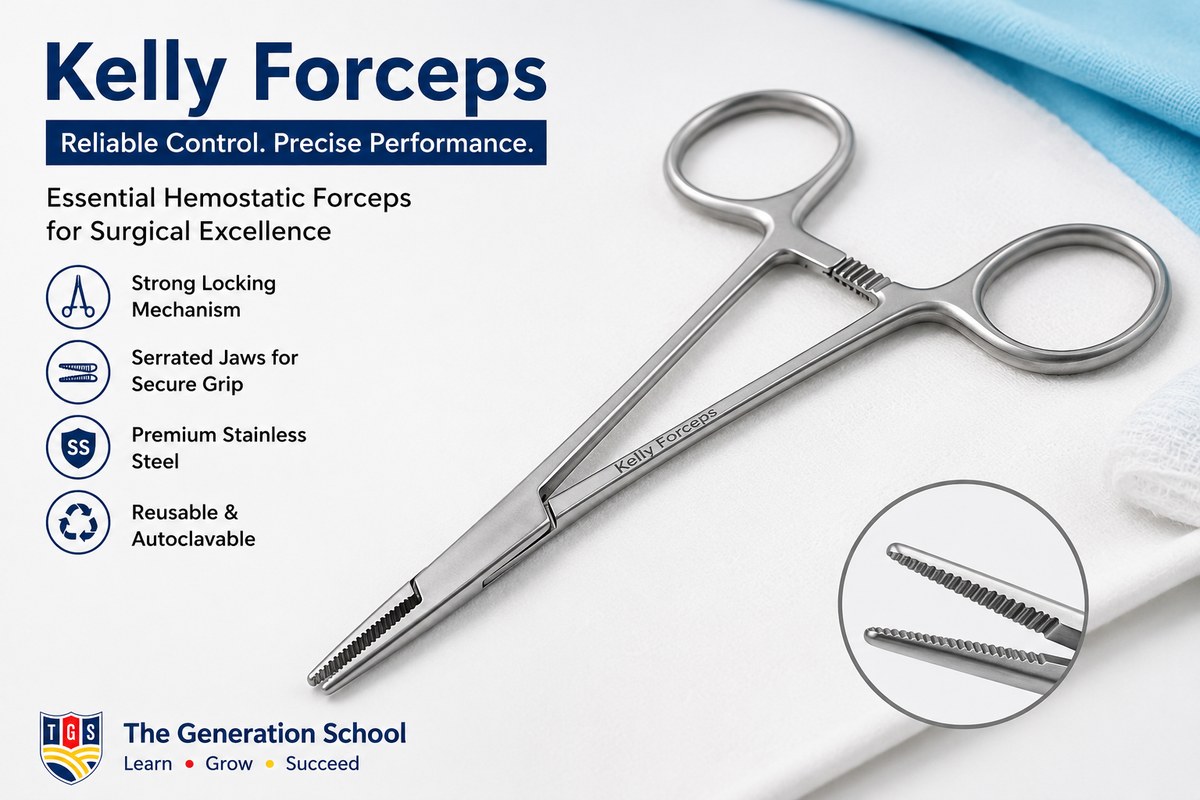
The instrument typically features two finger rings, long shanks, a ratchet locking mechanism, a box-lock joint, and serrated jaws. The finger-ring design allows the user to hold and manipulate the instrument comfortably, while the ratchet mechanism enables the jaws to remain locked at a selected pressure.
This locking capability is especially useful when a surgeon needs to maintain a clamp without continuously applying hand pressure.
Kelly Forceps are commonly available in both straight and curved configurations. The appropriate version depends on the procedure, anatomical location, and user preference.
Main Parts of Kelly Forceps
Understanding the construction of Kelly Forceps helps explain their functionality.
Finger Rings
Two finger rings are located at the proximal end of the instrument. They provide control while opening, closing, and positioning the forceps.
A properly manufactured finger-ring design should feel smooth and comfortable without sharp or rough edges.
Ratchet Lock
The ratchet mechanism is positioned near the finger rings. It allows the user to lock the forceps at different levels of pressure.
Reliable ratchet engagement is an important quality consideration. The mechanism should lock securely while also allowing controlled release.
Shanks
The shanks connect the finger rings to the joint and jaws. Their length provides leverage and helps the user access the surgical field.
Box Lock
The box-lock joint allows the two halves of the instrument to move together. Accurate alignment at this point contributes to smooth operation and proper jaw closure.
Serrated Jaws
One of the important identifying features of traditional Kelly Forceps is the pattern of serrations on the jaws. Kelly clamps generally have transverse serrations on the distal portion of the jaw rather than extending across the entire jaw surface.
This characteristic can help differentiate them from certain other hemostatic forceps.
Common Uses of Kelly Forceps
The primary function of Kelly Forceps is clamping and controlling structures during procedures. However, their practical design makes them useful for several tasks.
1. Clamping Blood Vessels
Kelly Forceps can be used to temporarily clamp blood vessels and assist with hemostasis during surgery. By applying controlled pressure, the instrument helps limit blood flow while the surgeon completes another step of the procedure.
The suitability of a particular clamp depends on the vessel size and surgical situation.
2. Controlling Bleeding
Hemostasis is essential during surgery because excessive bleeding can obstruct visibility and complicate a procedure.
Kelly hemostatic forceps may be used to clamp bleeding points temporarily, allowing the surgical team to manage the area more effectively.
3. Grasping Tissue
Depending on the procedure and tissue involved, Kelly Forceps may also be used for controlled tissue grasping.
Because surgical tissues vary significantly in strength and sensitivity, the appropriate instrument should always be selected according to the intended clinical use.
4. Holding Surgical Materials
In some procedures, Kelly clamps may assist in holding or manipulating surgical materials.
Their ratchet mechanism allows them to maintain a stable grip without requiring continuous manual pressure.
5. General Surgical Applications
Kelly Forceps can be found in various general surgical sets. Their versatility makes them familiar instruments in operating rooms, clinics, educational facilities, and other professional healthcare environments.
Straight Kelly Forceps vs. Curved Kelly Forceps
Kelly Forceps are commonly manufactured in straight and curved versions. Although their fundamental mechanism is similar, their shapes can make them suitable for different handling requirements.
Straight Kelly Forceps
Straight Kelly Forceps have jaws that continue in a straight line from the shanks.
They may be useful when the surgical site is clearly visible and direct access is required. The straight pattern can also make positioning straightforward in certain procedures.
Curved Kelly Forceps
Curved Kelly Forceps feature curved jaws at the working end.
The curved profile can improve access around structures and may provide better visibility in some surgical fields. The curve can also help the user approach tissue or vessels from a different angle.
The decision between straight and curved Kelly Forceps should be based on the specific procedure and professional preference.
Kelly Forceps vs. Mosquito Forceps
Kelly Forceps and Mosquito Forceps are both hemostatic instruments, but they should not automatically be considered interchangeable.
Mosquito Forceps are generally smaller and more delicate. They are commonly associated with clamping smaller vessels and working in finer surgical areas.
Kelly Forceps are typically larger and more robust. Their size makes them appropriate for situations where a stronger or larger hemostatic instrument is required.
Another difference can be found in the jaw serrations. Traditional Kelly Forceps usually have serrations extending along part of the jaw, while many Mosquito Forceps have serrations extending more fully along the jaw.
Instrument patterns can vary by manufacturer, so buyers should always review product specifications.
Kelly Forceps vs. Crile Forceps
Kelly and Crile Forceps can appear very similar at first glance. One of the traditional distinctions involves their serrations.
Kelly Forceps generally have transverse serrations on approximately the distal half of the jaws. Crile Forceps typically have transverse serrations extending along the full length of the jaws.
This difference is important when identifying instruments or ordering a specific pattern.
Healthcare buyers should therefore avoid selecting an instrument based only on overall appearance. Product dimensions, jaw pattern, curvature, material, and intended use should all be checked.
Material Used in Kelly Forceps
Surgical forceps are commonly manufactured from surgical-grade stainless steel. Stainless steel is widely used because it can provide a combination of strength, corrosion resistance, durability, and suitability for repeated processing when the instrument is designed as reusable.
The exact steel grade and manufacturing requirements can vary according to product specifications and applicable standards.
For reusable Kelly Forceps, material quality is especially important because the instrument may undergo repeated cleaning and sterilization cycles.
Poor-quality materials or inadequate manufacturing can contribute to problems such as corrosion, staining, joint stiffness, surface defects, or premature wear.
Important Quality Features
For professional medical buyers, price should not be the only consideration. Several functional characteristics should be examined.
Accurate Jaw Alignment
When the forceps are closed, the jaws should align correctly. Poor alignment can affect grip and instrument performance.
Consistent Serrations
Jaw serrations should be properly formed and matched. Irregular or damaged serrations may reduce the quality of the grip.
Smooth Box-Lock Movement
The instrument should open and close smoothly. Excessive looseness or stiffness may indicate manufacturing or maintenance issues.
Secure Ratchet Mechanism
The ratchet should engage consistently at its intended positions and release in a controlled manner.
Proper Surface Finish
A well-finished surgical instrument should have a clean, professional surface without obvious burrs, cracks, sharp unintended edges, or other visible defects.
Depending on specifications, surgical instruments may be supplied with different surface finishes.
Corrosion Resistance
Reusable instruments are exposed to moisture, cleaning agents, disinfectants, and sterilization processes. Appropriate material selection, manufacturing, maintenance, and processing help support corrosion resistance and instrument longevity.
Manufacturing Process of Kelly Forceps
The exact manufacturing process varies between manufacturers, but producing reusable surgical forceps generally involves multiple controlled stages.
Material selection is followed by forming or forging the basic instrument components. Machining processes help establish accurate dimensions, joint geometry, jaw profiles, and ratchet teeth.
The two halves must then be carefully assembled so the box lock moves correctly and the jaws meet as intended.
Additional processes may include heat treatment, grinding, serration formation, polishing, surface finishing, cleaning, inspection, and functional testing.
Quality control is particularly important because small variations in jaw alignment, ratchet engagement, joint movement, or surface condition can affect instrument performance.
Cleaning and Sterilization Considerations
Reusable Kelly Forceps must be processed according to the instrument manufacturer’s validated instructions and the healthcare facility’s infection-control procedures.
After use, contamination should not be allowed to dry unnecessarily on the instrument. During cleaning, particular attention may be required around the box lock, ratchet teeth, jaw serrations, and other areas where debris can collect.
The instrument should generally be handled in an open or unlocked position during processing when required by its instructions for use, so cleaning agents and sterilization processes can reach relevant surfaces.
After cleaning, instruments should be inspected for cleanliness, corrosion, damage, alignment, and proper function.
Sterilization parameters should not be assumed simply because an instrument is made of stainless steel. Users should follow the manufacturer’s instructions for use and the validated sterilization protocol applicable to their facility.
How to Choose High-Quality Kelly Forceps
Medical buyers, distributors, hospitals, and importers should evaluate several factors before placing an order.
First, confirm whether straight or curved forceps are required. Next, check the exact size, jaw pattern, serration design, material specification, surface finish, and reusable or single-use status.
Buyers should also consider manufacturing consistency. When ordering instruments in bulk, uniformity from one unit to another becomes particularly important.
A professional evaluation may include checking:
- Jaw alignment and closure
- Ratchet engagement
- Box-lock movement
- Serration consistency
- Surface finish
- Instrument dimensions
- Material specifications
- Packaging and labeling
- Traceability requirements
- Applicable regulatory and quality documentation
For OEM or private-label orders, additional requirements may include laser marking, custom packaging, catalog numbers, branding, and customer-specific specifications.
Importance of Quality Control
Quality control plays a central role in surgical instrument manufacturing.
Visual inspection alone may not be enough. Functional testing can help confirm that the instrument opens and closes smoothly, locks properly, maintains appropriate alignment, and does not contain obvious manufacturing defects.
Manufacturers supplying professional medical markets should maintain documented quality processes appropriate to the product and target market.
For distributors and importers, requesting relevant technical documentation can help determine whether a supplier is capable of providing consistent products.
Kelly Forceps for Hospitals and Distributors
Hospitals typically need instruments that provide reliable performance and can fit into established surgical workflows.
Distributors have additional considerations because they may purchase large quantities and supply multiple healthcare facilities. Product consistency, packaging, documentation, order fulfillment, and communication can therefore be as important as the instrument itself.
A supplier offering Kelly Forceps for international markets should be able to provide clear product specifications, including pattern, size, material, finish, packaging, and intended use.
Buyers should also confirm applicable regulatory requirements in their destination market before importing or distributing medical devices.
OEM and Private Label Kelly Forceps
OEM manufacturing can be useful for surgical instrument brands, wholesalers, and distributors that want products supplied according to their own specifications.
Depending on the manufacturer’s capabilities and applicable regulations, customization may include product dimensions, straight or curved patterns, surface finishes, laser markings, packaging, labels, and catalog references.
However, customization should never compromise instrument functionality or applicable quality requirements.
Clear technical specifications should be agreed upon before production, particularly for large-volume orders.
Why Proper Instrument Selection Matters
Surgical forceps may appear simple, but small design differences can significantly influence how an instrument performs.
Kelly Forceps, Crile Forceps, Mosquito Forceps, and other hemostatic clamps each have characteristics suited to particular applications. Selecting an instrument solely because it looks similar to another pattern can lead to incorrect purchasing decisions.
Hospitals and distributors should therefore identify instruments by their specifications rather than by appearance alone.
This is particularly important for bulk procurement, tenders, private-label manufacturing, and international orders where replacing incorrectly specified products can be costly.
Frequently Asked Questions About Kelly Forceps
What are Kelly Forceps used for?
Kelly Forceps are primarily used as hemostatic clamps to grasp or clamp structures such as blood vessels and assist in controlling bleeding during surgical procedures. Their exact use depends on the clinical situation and instrument specifications.
Are Kelly Forceps available in straight and curved patterns?
Yes. Kelly Forceps are commonly available in both straight and curved versions.
What is the difference between Kelly and Mosquito Forceps?
Mosquito Forceps are generally smaller and more delicate, while Kelly Forceps are typically larger and more robust. They may therefore be selected for different vessel sizes and surgical requirements.
What is the difference between Kelly and Crile Forceps?
A traditional distinguishing feature is the jaw serration pattern. Kelly Forceps generally have transverse serrations on the distal portion of the jaws, while Crile Forceps typically have serrations extending along the full jaw length.
Are Kelly Forceps reusable?
Many Kelly Forceps are manufactured as reusable surgical instruments, but this depends on the specific product. Always verify the manufacturer’s labeling and instructions for use.
How should Kelly Forceps be sterilized?
Reusable Kelly Forceps should be cleaned and sterilized according to the manufacturer’s validated instructions and the healthcare facility’s approved reprocessing procedures.
Conclusion
Kelly Forceps are versatile hemostatic instruments widely associated with clamping blood vessels, assisting with bleeding control, and handling structures during surgical procedures. Their finger-ring handles, box-lock joint, ratchet mechanism, and serrated jaws provide the controlled grip required for many surgical applications.
Straight and curved Kelly Forceps offer different approaches to the surgical field, while their size and jaw design help distinguish them from instruments such as Mosquito and Crile Forceps.