

Table of Contents
- Introduction
- What Is a Medical Instruments Manufacturer?
- Types of Medical Instruments Manufactured
- Manufacturing Process Explained
- Raw Materials Used
- Importance of Quality Control
- International Certifications and Standards
- OEM and Private Label Manufacturing
- Medical Instruments Manufacturer vs. Distributor
- Industries Served
- Factors to Consider When Choosing a Manufacturer
- Why Pakistan Is a Global Hub for Medical Instruments
- Latest Innovations in Medical Instrument Manufacturing
- Frequently Asked Questions
- Conclusion
Introduction
Healthcare professionals rely on precision, durability, and reliability every day. Whether performing complex surgeries or routine medical procedures, the quality of medical instruments directly impacts patient outcomes. This is why choosing a trusted Medical Instruments Manufacturer is one of the most important decisions hospitals, distributors, importers, and healthcare organizations can make.
A professional manufacturer does much more than produce surgical tools. They invest in research, engineering, precision machining, quality testing, sterilization compatibility, and international compliance to deliver products that meet the highest medical standards.
This comprehensive guide explains everything you need to know about medical instrument manufacturing, including production processes, certifications, quality assurance, OEM services, and how to select the right manufacturing partner.
What Is a Medical Instruments Manufacturer?
A Medical Instruments Manufacturer is a company that designs, engineers, manufactures, tests, and supplies medical devices and surgical instruments used by healthcare professionals worldwide.
These manufacturers produce instruments for:
- General Surgery
- Orthopedic Surgery
- Dental Procedures
- Neurosurgery
- Cardiovascular Surgery
- ENT Procedures
- Ophthalmic Surgery
- Gynecology
- Plastic Surgery
- Veterinary Applications
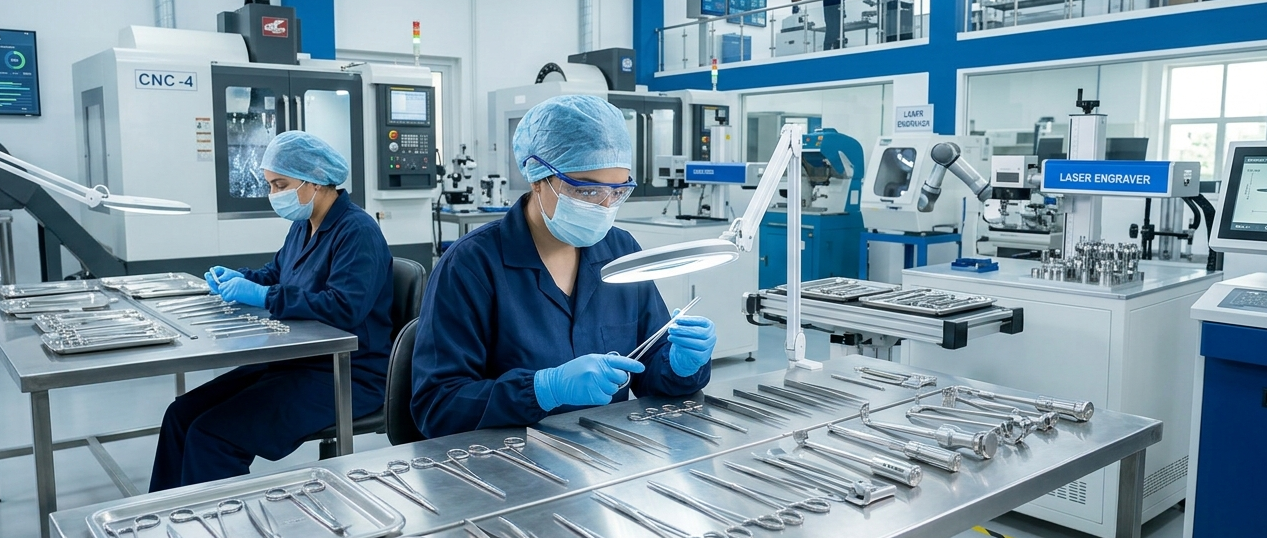
Modern manufacturers combine advanced engineering, skilled craftsmanship, CNC machining, and strict quality management systems to ensure every instrument performs reliably.
Types of Medical Instruments Manufactured
A professional manufacturer produces thousands of different instruments across multiple specialties.
Surgical Instruments
Examples include:
- Scissors
- Needle Holders
- Forceps
- Hemostats
- Retractors
- Clamps
- Bone Rongeurs
- Curettes
Dental Instruments
Common dental products include:
- Extraction Forceps
- Elevators
- Mirrors
- Explorers
- Scalers
- Bone Files
- Luxating Instruments
Orthopedic Instruments
Orthopedic tools include:
- Bone Holding Forceps
- Osteotomes
- Bone Chisels
- Bone Saws
- Retractors
- Reduction Forceps
Gynecology Instruments
These include:
- Speculums
- Uterine Curettes
- Dilators
- Forceps
- Scissors
Ophthalmic Instruments
Manufacturers also produce precision instruments such as:
- Eye Scissors
- Micro Forceps
- Needle Holders
- Corneal Instruments
Manufacturing Process of Medical Instruments
Professional manufacturing involves multiple precision steps.
1. Product Design
Engineers create CAD models that meet international healthcare requirements while improving ergonomics and functionality.
2. Material Selection
High-quality stainless steel is selected according to instrument type.
Popular grades include:
- AISI 420
- AISI 440A
- AISI 440C
- Medical-grade stainless steel
Titanium may also be used for lightweight surgical instruments.
3. Forging
Steel is heated and forged into the required shape.
Forging improves:
- Strength
- Durability
- Wear resistance
4. CNC Machining
Computer-controlled machines ensure:
- Precise dimensions
- Consistent quality
- High repeatability
5. Grinding and Shaping
Experienced technicians refine:
- Cutting edges
- Jaw alignment
- Serrations
- Surface finish
6. Heat Treatment
Heat treatment enhances:
- Hardness
- Corrosion resistance
- Mechanical strength
7. Polishing
Manufacturers provide various finishes including:
- Mirror Finish
- Satin Finish
- Matte Finish
These finishes improve corrosion resistance and ease of cleaning.
8. Assembly
Multi-component instruments are assembled carefully to ensure:
- Smooth movement
- Proper locking
- Perfect alignment
9. Quality Inspection
Every instrument undergoes multiple inspections before packaging.
10. Packaging
Products are packed using:
- Individual poly bags
- Sterile pouches
- Blister packaging
- Custom OEM packaging
Raw Materials Used
Quality begins with premium raw materials.
Common materials include:
| Material | Advantages |
|---|---|
| Stainless Steel 420 | Excellent corrosion resistance |
| Stainless Steel 440A | High hardness |
| Stainless Steel 440C | Superior edge retention |
| Titanium | Lightweight and durable |
| Tungsten Carbide | Long-lasting cutting performance |
Using certified materials significantly increases instrument lifespan.
Importance of Quality Control
A reputable Medical Instruments Manufacturer follows strict quality assurance procedures.
These include:
- Incoming material inspection
- Dimensional measurement
- Hardness testing
- Corrosion resistance testing
- Functional testing
- Cutting performance testing
- Passivation testing
- Final inspection
Quality control ensures every instrument meets customer specifications before shipment.
International Certifications and Standards
Reliable manufacturers comply with globally recognized standards.
Important certifications include:
ISO 13485
Specifically designed for medical device manufacturing.
CE Marking
Demonstrates compliance with European medical regulations.
FDA Registration
Required for supplying many medical devices to the United States market.
Good Manufacturing Practices (GMP)
Ensures consistent manufacturing quality and regulatory compliance.
OEM and Private Label Manufacturing
Many importers prefer OEM manufacturing.
OEM services allow buyers to:
- Add company logos
- Create custom packaging
- Design exclusive instruments
- Develop new products
- Customize finishes
- Select branding options
Private labeling helps distributors build strong market recognition.
Medical Instruments Manufacturer vs. Distributor
| Manufacturer | Distributor |
|---|---|
| Produces instruments | Sells finished products |
| Offers OEM services | Usually limited customization |
| Better pricing | Higher pricing |
| Full production control | Limited control |
| Custom development | Mostly standard inventory |
Buying directly from manufacturers often results in better pricing and greater customization.
Industries Served
Medical instrument manufacturers supply products to various industries.
These include:
Hospitals
General and specialty hospitals require reliable surgical instruments.
Clinics
Private clinics purchase instruments for routine procedures.
Medical Distributors
Distributors import products for regional healthcare markets.
Government Healthcare Projects
Large public healthcare programs require certified manufacturers.
Veterinary Hospitals
Veterinary surgeons use specialized instruments for animal care.
Educational Institutions
Medical colleges require instruments for teaching and laboratory practice.
Factors to Consider When Choosing a Medical Instruments Manufacturer
Selecting the right manufacturing partner involves evaluating several important factors.
Manufacturing Experience
Choose companies with years of experience in surgical instrument production.
Certifications
Ensure they possess:
- ISO 13485
- CE
- FDA (if required)
Production Capacity
The manufacturer should handle both small and bulk orders efficiently.
Quality Assurance
Ask about:
- Inspection procedures
- Material traceability
- Testing methods
OEM Capabilities
Reliable manufacturers provide:
- Logo engraving
- Custom packaging
- Product customization
- Private labeling
Export Experience
Experienced exporters understand:
- International shipping
- Documentation
- Customs requirements
- Global compliance
Customer Support
Professional communication and after-sales service help build long-term partnerships.
Why Pakistan Is a Global Hub for Medical Instruments
Pakistan, particularly the city of Sialkot, has earned an outstanding reputation in the medical and surgical instrument industry.
Key advantages include:
- Decades of manufacturing expertise
- Highly skilled craftsmen
- Competitive pricing
- Advanced manufacturing facilities
- Strong export infrastructure
- Worldwide customer base
- OEM specialization
- Flexible production capacity
Many international healthcare brands source instruments from Pakistani manufacturers due to their balance of quality and affordability.
Latest Innovations in Medical Instrument Manufacturing
The industry continues to evolve through innovation.
Emerging trends include:
CNC Precision Manufacturing
Computer-controlled production delivers exceptional accuracy.
Laser Marking
Permanent laser engraving improves traceability and branding.
Robotic Manufacturing
Automation increases consistency while reducing production errors.
Advanced Surface Coatings
Modern coatings improve corrosion resistance and extend instrument life.
Digital Quality Inspection
3D measurement systems detect microscopic deviations before products reach customers.
Sustainable Manufacturing
Manufacturers increasingly adopt eco-friendly production processes and recyclable packaging to reduce environmental impact.
Benefits of Working with a Professional Medical Instruments Manufacturer
Partnering directly with a trusted manufacturer offers several advantages:
- Consistent product quality
- Competitive factory pricing
- Access to OEM and ODM services
- Faster production turnaround
- Strict compliance with international standards
- Reliable global shipping
- Dedicated customer support
- Long-term business relationships
- Flexible order quantities
- Continuous product innovation
These benefits help distributors, hospitals, and healthcare suppliers build a dependable supply chain.
Frequently Asked Questions (FAQs)
What does a medical instruments manufacturer do?
A medical instruments manufacturer designs, produces, tests, and supplies surgical and medical instruments for healthcare professionals worldwide.
Which materials are commonly used?
Most premium instruments are made from medical-grade stainless steel, titanium, or tungsten carbide, depending on their intended use.
Can manufacturers provide custom branding?
Yes. Many manufacturers offer OEM and private label services, including laser logo marking, custom packaging, and exclusive product designs.
Why are certifications important?
Certifications such as ISO 13485, CE, and FDA-related compliance demonstrate adherence to recognized quality and safety standards, giving buyers greater confidence.
What industries purchase medical instruments?
Hospitals, clinics, distributors, government healthcare agencies, dental practices, veterinary hospitals, and medical universities are among the primary buyers.
How can I verify a manufacturer’s quality?
Request certification documents, product samples, quality inspection reports, and references from previous customers. Reviewing production capabilities and testing procedures is also recommended.
Conclusion
Choosing the right Medical Instruments Manufacturer is a strategic decision that directly influences product quality, patient safety, and business success. The best manufacturers combine advanced technology, skilled craftsmanship, certified quality systems, and responsive customer support to deliver reliable medical instruments for global healthcare markets.