

Mosquito Forceps: A Complete Guide for Medical Buyers
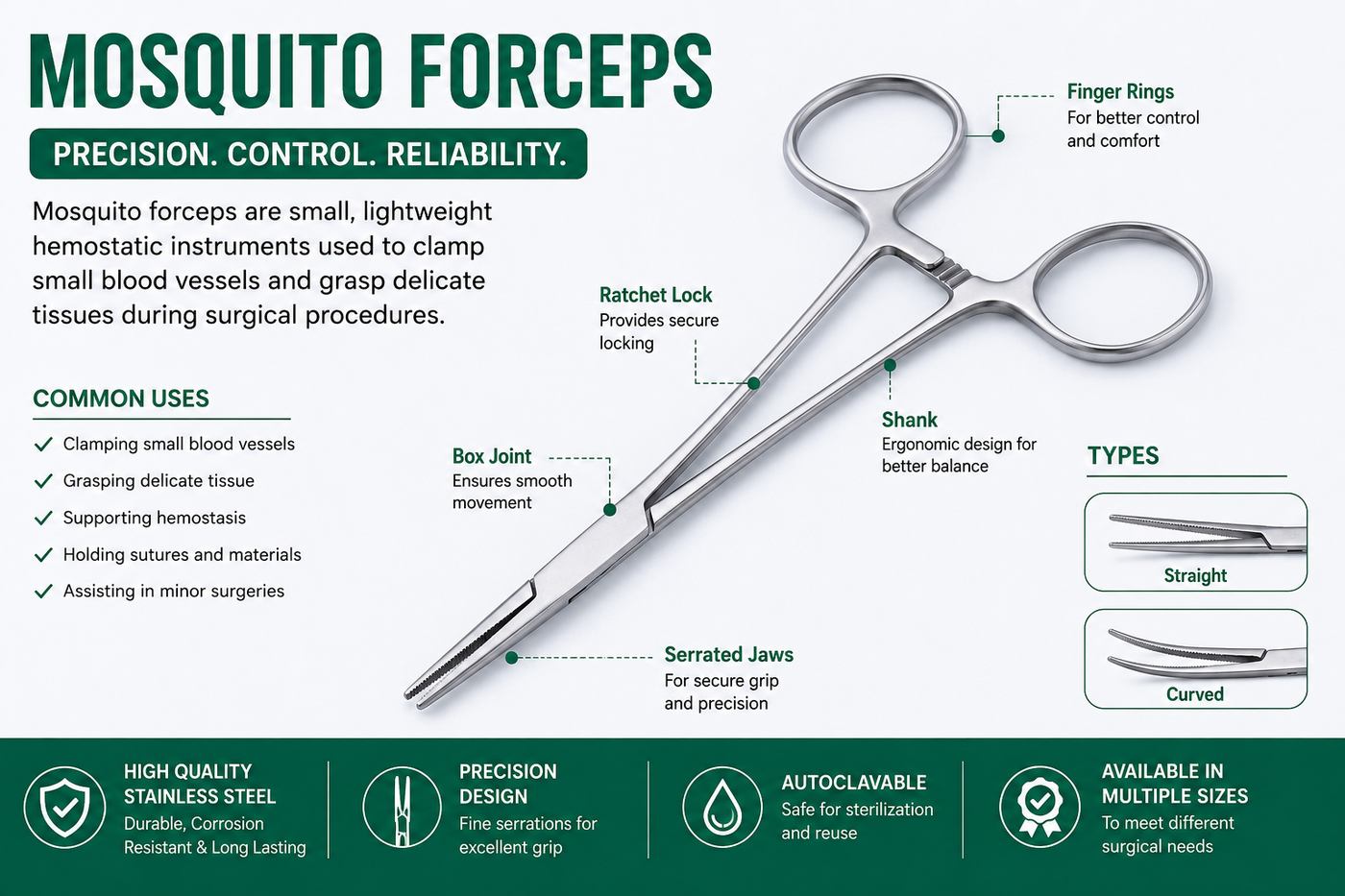
Mosquito forceps are small surgical instruments used for delicate clamping and grasping tasks. They are commonly found in operating rooms, clinics, emergency departments, dental setups, and surgical instrument sets.
These forceps are also known as mosquito hemostats or mosquito artery forceps. Their compact size makes them suitable for fine work. Surgeons may use them to clamp small blood vessels, grasp delicate tissue, or hold certain materials during appropriate procedures.
Mosquito forceps are available in different patterns. For example, straight and curved models are widely used. They also come in various lengths and finishes.
However, instrument quality can vary from one manufacturer to another. Therefore, buyers should check the jaw alignment, serrations, ratchet, joint movement, material, and surface finish before placing an order.
This guide explains the uses, types, features, manufacturing process, quality control, care, and purchasing factors related to mosquito forceps.
What Are Mosquito Forceps?
Mosquito forceps are small ring-handled surgical instruments with a locking mechanism.
They usually have narrow serrated jaws. The jaws can be straight or curved depending on the pattern.
When the user closes the handles, the jaws grip the selected vessel, tissue, or material. The ratchet then allows the instrument to remain locked.
As a result, the surgeon does not need to apply constant finger pressure.
Mosquito forceps are generally smaller and finer than many standard artery forceps. This makes them useful in procedures where precision and delicate handling are important.
The main parts include:
- Jaws
- Serrations
- Box joint
- Shanks
- Ratchet
- Finger rings
Each part contributes to the overall function of the instrument.
What Are Mosquito Forceps Used For?
The main purpose of mosquito forceps is to provide controlled clamping and grasping in smaller or more delicate areas.
Common uses may include:
- Clamping small blood vessels
- Supporting hemostasis
- Grasping delicate tissue
- Holding small sutures or materials
- Assisting with dissection
- Handling fine surgical structures
- Supporting minor surgical procedures
Their exact use depends on the procedure and the specific instrument pattern.
Therefore, healthcare professionals should always select a forceps that matches the intended application.
Why Are Mosquito Forceps Important?
Small blood vessels can be difficult to control with larger instruments.
This is where mosquito forceps become useful.
Their narrow jaws provide better access to small structures. In addition, the ratchet mechanism helps maintain a controlled grip.
Because of their smaller size, they can also provide better visibility in fine surgical areas.
For this reason, mosquito hemostats are often included in general surgical sets, minor surgery sets, and specialty instrument trays.
Main Parts of Mosquito Forceps
Although mosquito forceps have a compact design, several parts are important for reliable performance.
Jaws
The jaws are the working ends of the instrument.
They should meet correctly when closed. Proper alignment improves grip and overall control.
Poorly aligned jaws may reduce performance.
Serrations
The inner surfaces of the jaws usually contain serrations.
These grooves improve grip and help reduce slipping.
The serrations should be even, clean, and consistent.
Box Joint
The box joint connects the two halves of the instrument.
It should allow smooth opening and closing.
A joint that is too tight may be difficult to operate. On the other hand, a loose joint may reduce precision.
Ratchet
The ratchet is located near the finger rings.
It allows the instrument to lock at selected positions.
This feature helps maintain grip without continuous hand pressure.
Finger Rings
The finger rings provide control during use.
They should have smooth edges and a comfortable finish.
Types of Mosquito Forceps
Several mosquito forceps patterns are available.
The most common differences include jaw shape, size, and surface finish.
Straight Mosquito Forceps
Straight mosquito forceps have jaws that follow the same line as the shanks.
They offer direct access to the target area.
These forceps may be useful when the surgical site is visible and easy to approach.
Curved Mosquito Forceps
Curved mosquito forceps have a curved working end.
The curve can improve access around nearby structures.
In addition, it may help the surgeon maintain better visibility during the procedure.
Small Mosquito Forceps
Small mosquito forceps are designed for very fine handling.
Their compact size makes them suitable for minor surgery and delicate procedures.
Long Mosquito Forceps
Longer mosquito forceps provide additional reach.
They may be selected when the target area is deeper or less accessible.
However, the correct size should always depend on the intended use.
Straight vs. Curved Mosquito Forceps
Both straight and curved models are common.
| Feature | Straight Mosquito Forceps | Curved Mosquito Forceps |
|---|---|---|
| Jaw Shape | Straight | Curved |
| Access | Direct | Angled |
| Visibility | Good in open areas | Useful around structures |
| Control | Direct grip | Improved access in some areas |
| Availability | Multiple sizes | Multiple sizes |
The right choice depends on the procedure.
For distributors, offering both options can help meet different customer requirements.
Features of High-Quality Mosquito Forceps
Quality is an important factor when buying surgical instruments.
A good mosquito forceps should offer precise handling and reliable mechanical function.
Accurate Jaw Alignment
The jaws should meet evenly when the instrument closes.
Misaligned jaws can reduce gripping ability.
Therefore, manufacturers should inspect this feature carefully.
Fine Serrations
The serrations should be well formed.
They should also remain consistent from one instrument to another.
Good serrations help the user maintain a secure grip.
Smooth Joint Movement
The box joint should move smoothly.
It should not feel excessively stiff or loose.
Smooth movement can improve comfort and control.
Reliable Ratchet
The ratchet should engage properly.
Each locking position should work as intended.
It should also release smoothly when required.
Balanced Tension
The forceps should have controlled tension.
If the instrument is too stiff, it may become uncomfortable to use.
If it is too loose, precision may decrease.
Smooth Surface Finish
The surface should be properly finished.
It should not contain unnecessary sharp edges, deep scratches, burrs, or visible manufacturing defects.
Stainless Steel Mosquito Forceps
Many reusable mosquito forceps are made from stainless steel.
Suitable stainless steel can provide several important benefits.
These may include:
- Good strength
- Durability
- Corrosion resistance
- Smooth finishing
- Reusability
- Compatibility with proper reprocessing
However, stainless steel quality alone does not determine instrument performance.
Manufacturing accuracy is equally important.
For example, even good material cannot compensate for poor jaw alignment or a weak ratchet.
Therefore, buyers should check both material specifications and workmanship.
Manufacturing Process of Mosquito Forceps
Manufacturing quality mosquito forceps requires several controlled stages.
The exact process may vary according to the manufacturer. However, common steps include the following.
1. Raw Material Selection
The manufacturer selects suitable stainless steel according to the required specification.
Good raw material helps support durability and reliable performance.
2. Forming
The basic shape of the instrument is created.
This stage establishes the overall profile of the forceps.
Accurate forming is important because later stages depend on proper dimensions.
3. Machining
Important areas are then machined.
These may include:
- Jaws
- Box joint
- Ratchet
- Finger rings
Precision is especially important because mosquito forceps are small instruments.
4. Serration Formation
The manufacturer creates fine serrations inside the jaws.
These serrations should remain uniform throughout the batch.
Poor serrations may affect grip.
5. Joint Fitting
Both halves of the instrument are assembled.
The joint should provide smooth movement without excessive play.
6. Grinding
Grinding helps create the final shape.
It also removes rough edges and extra material.
7. Heat Treatment
Depending on the material and product specification, controlled heat treatment may be used.
This can help achieve the desired mechanical properties.
8. Polishing
The instrument is polished or finished according to the required surface specification.
A consistent finish improves both appearance and product quality.
9. Cleaning
The forceps are cleaned to remove manufacturing residues.
Surface treatment may also be performed where required.
10. Final Inspection
The finished instruments undergo inspection.
Inspectors may check:
- Jaw alignment
- Serrations
- Joint movement
- Ratchet function
- Dimensions
- Surface finish
- Marking
- Overall workmanship
This final inspection helps maintain production consistency.
Quality Control for Mosquito Forceps
Quality control is especially important because mosquito forceps are used for fine surgical work.
A reliable manufacturer should carry out inspections during production and before packing.
Jaw Alignment Check
The jaws should meet correctly.
Both sides should align without twisting or uneven contact.
Serration Check
The serrations should be fine, even, and properly formed.
Ratchet Test
The ratchet should lock at the intended positions.
It should also release without difficulty.
Joint Test
The joint should move smoothly.
Excessive stiffness or looseness may indicate a quality issue.
Dimension Check
The overall length and jaw dimensions should match the approved specification.
Surface Inspection
Inspectors should look for:
- Burrs
- Cracks
- Deep scratches
- Rough edges
- Stains
- Uneven finishing
Functional Inspection
The complete instrument should be tested for smooth and reliable operation before packaging.
Cleaning and Sterilization of Mosquito Forceps
Reusable mosquito forceps require proper cleaning and sterilization.
Healthcare facilities should follow the manufacturer’s validated instructions and applicable infection-control procedures.
Special attention should be given to the jaws, serrations, joint, and ratchet.
These areas can collect contamination if cleaning is incomplete.
General care steps may include:
- Handle used instruments safely.
- Avoid allowing contamination to dry.
- Clean the instrument using an approved method.
- Pay attention to serrations and joints.
- Rinse thoroughly.
- Dry completely.
- Inspect for damage.
- Follow validated sterilization instructions.
- Store the instrument correctly.
Proper care can help maintain instrument performance over time.
However, damaged or malfunctioning forceps should be removed from service according to facility procedures.
How to Choose the Right Mosquito Forceps
Medical buyers should evaluate several features before ordering.
Choose Straight or Curved
First, decide whether you need straight or curved jaws.
Straight models offer direct access.
Curved models may provide better access around nearby structures.
Select the Correct Size
Mosquito forceps come in different lengths.
Therefore, buyers should clearly state their size requirements.
Check Jaw Design
Look at the jaw length and serration pattern.
The jaws should be fine enough for the intended use.
Test the Ratchet
A good ratchet should lock and release smoothly.
For large orders, buyers may request samples before mass production.
Confirm Material
Ask the supplier for clear material specifications.
This is especially important for reusable surgical instruments.
Review Surface Finish
The finish should be uniform across the entire batch.
A consistent surface reflects better manufacturing control.
Buying Mosquito Forceps in Bulk
Hospitals, distributors, wholesalers, and importers should provide clear specifications when buying in bulk.
This can reduce misunderstandings and improve order accuracy.
| Specification | Details |
| Product | Mosquito Forceps |
| Type | Straight / Curved |
| Size | Buyer requirement |
| Jaw Pattern | Fine serrated |
| Material | Required specification |
| Finish | As required |
| Branding | Standard / OEM |
| Packaging | Individual / Bulk |
| Quantity | As required |
Buyers should also discuss lead time, packaging, labeling, shipping, documentation, and payment terms before confirming an order.
OEM and Private Label Mosquito Forceps
Many distributors prefer OEM surgical instruments.
OEM services allow buyers to sell instruments under their own brand.
Depending on the manufacturer and market requirements, customization may include:
- Company logo
- Brand name
- Product code
- Instrument size
- Straight or curved pattern
- Surface finish
- Laser marking
- Packaging
- Labels
- Barcodes
However, specifications should be approved before production begins.
A sample can also help confirm the required quality and design.
Why Production Consistency Matters
Consistency is very important in bulk surgical instrument orders.
A buyer may order hundreds or thousands of mosquito forceps.
If the jaw alignment, ratchet, size, or finish varies from one piece to another, customer complaints may increase.
Therefore, manufacturers should maintain consistent:
- Jaw alignment
- Serrations
- Dimensions
- Joint movement
- Ratchet function
- Surface finish
- Marking
- Packaging
Regular inspection can help identify problems before shipment.
Mosquito Forceps for Medical Distributors
Medical distributors usually require more than a competitive price.
They also need reliable supply and consistent quality.
For this reason, buyers should evaluate the complete supplier.
Important factors include:
- Manufacturing experience
- Quality control
- Production capacity
- Product consistency
- Documentation
- Export experience
- OEM services
- Packaging options
- Communication
- Delivery reliability
A dependable supplier should be able to maintain agreed specifications across repeat orders.
Frequently Asked Questions About Mosquito Forceps
What are mosquito forceps used for?
Mosquito forceps are commonly used to clamp small blood vessels, grasp delicate tissue, and handle fine structures during appropriate surgical procedures.
Why are they called mosquito forceps?
The name refers to their small and delicate design compared with larger hemostatic forceps.
Are mosquito forceps the same as artery forceps?
Mosquito forceps are a type of hemostatic or artery forceps. However, they are generally smaller and designed for finer work.
What is the difference between straight and curved mosquito forceps?
Straight mosquito forceps provide direct access. Curved mosquito forceps provide an angled working end that may improve access around structures.
Why do mosquito forceps have serrations?
The serrations improve grip and help reduce slipping.
What is the purpose of the ratchet?
The ratchet locks the forceps at selected positions. Therefore, the user does not need to keep constant pressure on the handles.
Are mosquito forceps reusable?
Many stainless steel mosquito forceps are designed for reuse. They must be cleaned, inspected, sterilized, and maintained according to the manufacturer’s instructions.
Can mosquito forceps be customized?
Yes. Many manufacturers offer OEM services such as logo marking, custom sizes, finishes, labels, packaging, and private branding.
What should buyers check before placing a bulk order?
Buyers should check size, jaw alignment, serrations, ratchet function, joint movement, material, finish, packaging, and supplier reliability.
Conclusion
Mosquito forceps are small but important surgical instruments. Their fine jaws and locking mechanism make them useful for delicate clamping and grasping tasks.
Straight and curved patterns are widely available. Different sizes also help healthcare professionals choose the right instrument for a specific procedure.