

Introduction
Modern healthcare demands precision, reliability, and innovation. Whether performing minimally invasive procedures or highly specialized surgeries, surgeons rely on instruments specifically designed for their clinical needs. Standard instruments often work well for routine procedures, but many hospitals and specialists require customized solutions that improve surgical accuracy, efficiency, and patient outcomes.
This is where a Custom Surgical Instruments Manufacturer becomes an essential partner rather than just another supplier. Custom surgical instruments are engineered to match specific surgical techniques, physician preferences, and unique medical procedures. From modifying handle designs to developing entirely new instruments, customization helps healthcare professionals achieve greater control and better clinical performance.
For hospitals, distributors, wholesalers, importers, and OEM buyers, selecting the right manufacturing partner is critical. Beyond product quality, factors such as regulatory compliance, material selection, precision manufacturing, and after-sales support determine long-term success.
This comprehensive guide explains everything you need to know about custom surgical instruments, including manufacturing processes, materials, quality standards, purchasing tips, and common mistakes to avoid.
Table of Contents
- What Is a Custom Surgical Instruments Manufacturer?
- Why Custom Surgical Instruments Matter
- Benefits of Custom Surgical Instruments
- Key Features
- Applications Across Medical Specialties
- Manufacturing Process
- Materials Used
- Quality Standards and Certifications
- Comparison: Standard vs Custom Instruments
- How to Choose the Right Manufacturer
- Common Buyer Mistakes
- Expert Buying Tips
- Frequently Asked Questions
- Final Summary
- Why Choose Professional Enterprises?
What Is a Custom Surgical Instruments Manufacturer?
A Custom Surgical Instruments Manufacturer designs, develops, modifies, and manufactures surgical instruments according to specific customer requirements instead of producing only standard catalog products.
Customization may include:
- Modified dimensions
- Special jaw configurations
- Personalized handle designs
- Custom engraving
- Brand logo marking
- Private labeling
- Specialized coatings
- Procedure-specific innovations
These manufacturers typically work closely with surgeons, hospitals, OEM companies, distributors, and medical device brands.
Why Custom Surgical Instruments Matter
Every surgical specialty has unique challenges. Instruments designed specifically for a surgeon’s preferred technique can:
- Improve surgical precision
- Reduce operating time
- Increase surgeon comfort
- Minimize tissue trauma
- Enhance patient safety
- Improve procedural consistency
Customization also enables medical device companies to create exclusive product lines that differentiate them from competitors.
Benefits of Custom Surgical Instruments
Choosing a reliable custom manufacturer offers several advantages.
Enhanced Surgical Precision
Custom-designed instruments allow surgeons to perform delicate procedures with greater control.
Better Ergonomics
Comfortable handles reduce hand fatigue during lengthy surgeries.
Brand Differentiation
OEM customers can launch exclusive instrument lines under their own brand.
Improved Workflow
Specialized instruments eliminate unnecessary instrument changes during procedures.
Higher Product Consistency
Professional manufacturers maintain precise dimensions across production batches.
Long-Term Cost Savings
Although customized instruments may require higher initial investment, improved durability and performance often reduce replacement costs.
Key Features of High-Quality Custom Surgical Instruments
A premium manufacturer typically provides:
- OEM manufacturing
- ODM product development
- Private labeling
- Laser logo engraving
- Customized dimensions
- Precision machining
- Mirror or satin finish
- Corrosion-resistant stainless steel
- Passivation treatment
- Individual quality inspection
- Sterile or non-sterile packaging
- Worldwide export capability
Applications Across Medical Specialties
Custom surgical instruments are widely used in:
General Surgery
- Forceps
- Scissors
- Needle holders
- Retractors
Orthopedic Surgery
- Bone holding forceps
- Rongeurs
- Osteotomes
- Bone chisels
Dental Surgery
- Extraction forceps
- Elevators
- Bone files
- Luxating instruments
Cardiovascular Surgery
- Vascular clamps
- Micro scissors
- Needle holders
Neurosurgery
- Fine dissectors
- Bipolar forceps
- Micro elevators
Plastic Surgery
- Delicate scissors
- Fine forceps
- Skin hooks
ENT Surgery
- Ear forceps
- Nasal speculums
- Laryngeal instruments
Gynecology
- Vaginal speculums
- Curettes
- Uterine forceps
Manufacturing Process
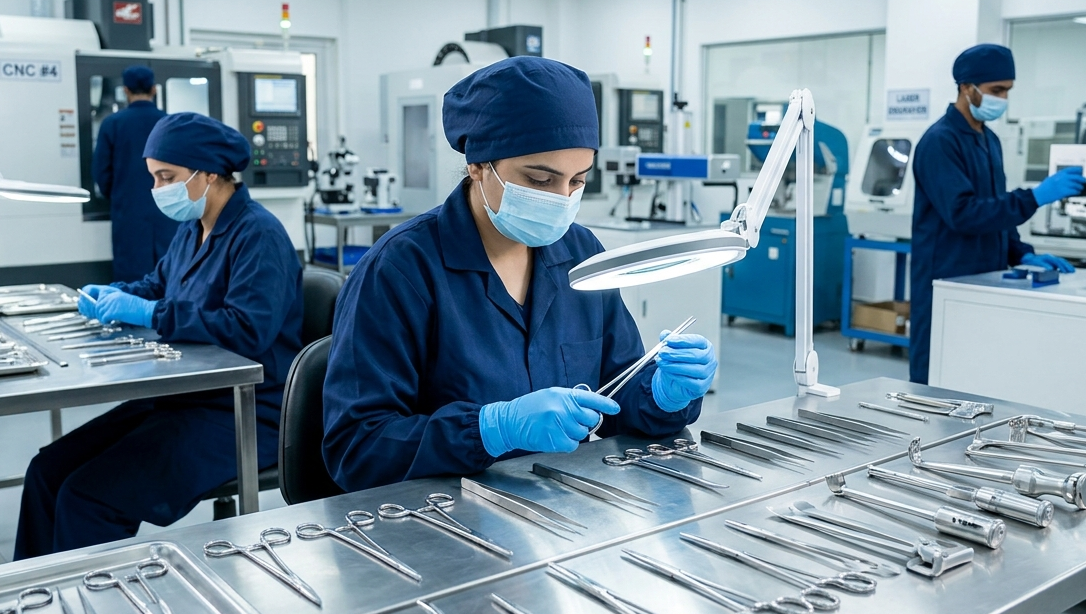
Producing custom surgical instruments requires advanced engineering and strict quality control.
1. Requirement Analysis
Engineers review customer drawings, samples, or surgical requirements.
2. CAD Design
3D models are created for technical evaluation.
3. Prototype Development
Prototype instruments are manufactured for testing.
4. Customer Approval
The customer reviews and approves the prototype before mass production.
5. Forging
High-grade stainless steel is forged into the desired shape.
6. CNC Machining
Precision machining ensures exact dimensions.
7. Heat Treatment
Improves hardness and durability.
8. Grinding & Finishing
Each instrument receives accurate finishing for smooth functionality.
9. Polishing
Mirror or satin finishes improve appearance and corrosion resistance.
10. Assembly
Multi-component instruments are assembled carefully.
11. Passivation
Chemical treatment enhances corrosion resistance.
12. Quality Inspection
Each product undergoes dimensional, functional, and visual inspection.
13. Packaging
Products are packed according to customer specifications.
Materials Used
Material selection directly affects instrument performance.
| Material | Advantages |
|---|---|
| German Stainless Steel | Excellent corrosion resistance |
| Japanese Stainless Steel | Superior edge retention |
| AISI 420 Stainless Steel | High hardness |
| AISI 410 Stainless Steel | Good durability |
| Tungsten Carbide Inserts | Extended cutting life |
| Titanium | Lightweight and MRI compatible |
Premium manufacturers only source certified medical-grade raw materials.
Quality Standards
An experienced manufacturer follows internationally recognized standards such as:
- ISO 13485
- CE Compliance
- FDA Manufacturing Guidelines
- GMP (Good Manufacturing Practices)
- Quality Management Systems
- Material Traceability
- Batch Inspection
- Hardness Testing
- Corrosion Resistance Testing
- Functional Testing
Consistent documentation ensures every production batch meets customer expectations.
Standard Instruments vs Custom Surgical Instruments
| Feature | Standard Instruments | Custom Instruments |
|---|---|---|
| Design | Fixed | Customized |
| Branding | Generic | Private Label |
| Ergonomics | Standard | Surgeon Specific |
| OEM Availability | Limited | Full OEM |
| Competitive Advantage | Low | High |
| Innovation | Limited | Unlimited |
How to Choose the Right Custom Surgical Instruments Manufacturer
Selecting the right supplier involves more than comparing prices.
Consider the following:
Manufacturing Experience
Look for manufacturers with extensive industry expertise.
Engineering Support
A dedicated design team is essential for custom development.
Certifications
Verify ISO 13485 and other quality certifications.
Material Quality
Only medical-grade stainless steel should be used.
Production Capacity
Ensure the manufacturer can handle future volume increases.
Communication
Responsive communication speeds up development and production.
Export Experience
Global logistics expertise minimizes shipping delays.
OEM Capabilities
Choose a supplier experienced in private labeling and branding.
Common Mistakes Buyers Make
Many medical buyers unknowingly make costly purchasing errors.
Choosing Based Only on Price
The lowest quote may compromise quality.
Ignoring Certifications
Lack of certification can create regulatory issues.
Not Requesting Samples
Always evaluate prototypes before placing bulk orders.
Overlooking Material Specifications
Material quality determines product lifespan.
Poor Communication
Unclear requirements often result in production delays.
Skipping Factory Audits
Whenever possible, inspect manufacturing facilities.
Ignoring After-Sales Support
Reliable suppliers provide technical assistance even after delivery.
Expert Buying Tips
Experienced procurement professionals recommend:
- Request technical drawings.
- Verify steel grades.
- Confirm heat treatment processes.
- Review inspection reports.
- Ask about production lead times.
- Test sample instruments.
- Discuss warranty policies.
- Clarify packaging requirements.
- Confirm export documentation.
- Build long-term supplier relationships instead of chasing the lowest price.
Frequently Asked Questions
1. What is a Custom Surgical Instruments Manufacturer?
A company that designs and manufactures surgical instruments according to customer specifications rather than only producing standard catalog items.
2. Can custom instruments include my company logo?
Yes. Most OEM manufacturers offer laser engraving and private labeling services.
3. What stainless steel is commonly used?
Medical-grade AISI 420, AISI 410, German stainless steel, Japanese stainless steel, and titanium are widely used.
4. What industries purchase custom surgical instruments?
Hospitals, medical distributors, importers, wholesalers, healthcare brands, and OEM companies.
5. How long does custom production take?
Depending on complexity, production typically ranges from 3 to 8 weeks after prototype approval.
6. Are custom instruments more expensive?
Initial tooling costs may be higher, but improved efficiency and product exclusivity often provide better long-term value.
7. What certifications should a manufacturer have?
Look for ISO 13485 compliance, CE standards, quality management systems, and adherence to FDA manufacturing guidelines where applicable.
Final Summary
A trusted Custom Surgical Instruments Manufacturer provides much more than manufacturing services. They become a strategic partner in developing innovative, reliable, and high-performance surgical solutions tailored to modern healthcare needs.
From precision engineering and premium stainless steel to rigorous quality inspections and worldwide export capabilities, the right manufacturing partner helps hospitals, distributors, wholesalers, importers, and OEM brands deliver better outcomes while strengthening their competitive position.
Investing in customization not only enhances surgical performance but also creates long-term value through improved efficiency, product differentiation, and customer satisfaction.
Why Choose Professional Enterprises?
Professional Enterprises is a trusted surgical and dental instruments manufacturer based in Sialkot, Pakistan. We provide OEM manufacturing, private labeling, premium stainless steel instruments, worldwide export services, competitive pricing, and strict quality control.
Whether you require customized surgical instruments, branded OEM solutions, or bulk manufacturing for international distribution, our experienced team is committed to delivering precision, consistency, and reliability.
Contact us today to request a free quotation for your surgical instrument requirements.