

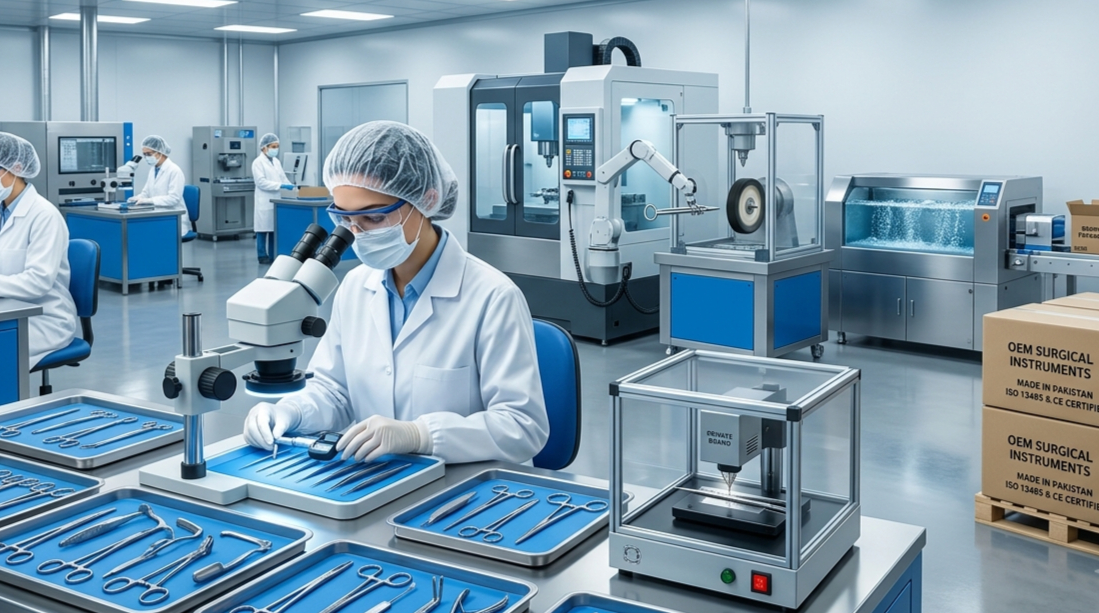
Introduction
The global healthcare industry is continuously evolving, and medical distributors, hospitals, importers, and healthcare brands are increasingly seeking customized products that reflect their own identity. This growing demand has made OEM Surgical Instruments one of the fastest-growing segments in the medical device industry.
OEM (Original Equipment Manufacturer) surgical instruments allow companies to market premium-quality medical instruments under their own brand name without investing in manufacturing facilities. Whether you are a medical distributor, hospital supplier, procurement company, or startup medical brand, OEM manufacturing provides a cost-effective and scalable solution for expanding your product portfolio.
Pakistan, particularly Sialkot, is recognized worldwide for manufacturing precision surgical instruments. With decades of craftsmanship, modern CNC technology, and internationally accepted quality standards, OEM manufacturers from Sialkot supply customized surgical instruments to customers in more than 140 countries.
In this comprehensive guide, you’ll learn everything about OEM surgical instruments, including manufacturing processes, customization options, quality standards, benefits, and how to choose the right manufacturing partner.
What Are OEM Surgical Instruments?
OEM Surgical Instruments are medical instruments manufactured by one company and sold under another company’s brand name.
Instead of building an expensive manufacturing facility, medical companies partner with experienced OEM manufacturers who produce instruments according to the buyer’s specifications.
OEM services typically include:
- Custom logo engraving
- Private labeling
- Custom packaging
- Product design modifications
- Instrument customization
- Exclusive product lines
- Bulk manufacturing
- Export documentation
This business model enables distributors and medical brands to focus on marketing, sales, and customer relationships while leaving manufacturing to experienced professionals.
Benefits of OEM Surgical Instruments
OEM manufacturing offers numerous advantages for medical businesses worldwide.
1. Brand Recognition
Companies can build their own medical brand by selling instruments with their own logo and packaging.
2. Lower Investment
OEM manufacturing eliminates the need for expensive factories, machinery, and production staff.
3. High Product Quality
Experienced manufacturers use advanced production techniques and strict quality control systems.
4. Faster Market Entry
Instead of spending years developing manufacturing capabilities, businesses can launch products quickly.
5. Cost Efficiency
Bulk manufacturing significantly reduces production costs, making products more competitive.
6. Flexible Production
OEM manufacturers can produce both small trial orders and large-volume shipments based on customer requirements.
OEM vs ODM vs Standard Manufacturing
Understanding the differences helps buyers choose the right manufacturing model.
| Feature | OEM | ODM | Standard Manufacturing |
|---|---|---|---|
| Custom Branding | ✔ | Limited | ✖ |
| Custom Design | ✔ | Partial | ✖ |
| Private Label | ✔ | ✔ | ✖ |
| Product Ownership | Customer Brand | Manufacturer Design | Manufacturer Brand |
| Custom Packaging | ✔ | ✔ | Limited |
| Product Modification | ✔ | Limited | No |
Types of OEM Surgical Instruments
Professional OEM manufacturers produce instruments across nearly every medical specialty.
General Surgery Instruments
- Surgical Scissors
- Tissue Forceps
- Hemostatic Forceps
- Needle Holders
- Retractors
- Clamps
Dental Instruments
- Extraction Forceps
- Elevators
- Scalers
- Dental Mirrors
- Bone Files
Orthopedic Instruments
- Bone Chisels
- Osteotomes
- Bone Holding Forceps
- Rongeurs
- Reduction Forceps
Gynecology Instruments
- Speculums
- Uterine Forceps
- Dilators
- Curettes
ENT Instruments
- Nasal Forceps
- Ear Instruments
- Laryngeal Instruments
Ophthalmic Instruments
- Eye Scissors
- Micro Forceps
- Needle Holders
Microsurgical Instruments
- Fine Forceps
- Micro Scissors
- Vascular Clamps
- Precision Needle Holders
Manufacturing Process
Professional OEM manufacturers follow a highly controlled production process.
Raw Material Selection
Only premium surgical-grade stainless steel, titanium, or tungsten carbide is selected.
Forging
High-pressure forging provides strength and durability.
CNC Machining
Computer-controlled machining ensures precise dimensions.
Heat Treatment
Improves hardness, flexibility, and long-term durability.
Grinding & Sharpening
Expert technicians create smooth surfaces and razor-sharp cutting edges.
Polishing
Mirror or satin finishes improve corrosion resistance and appearance.
Laser Logo Engraving
Customer logos and product codes are engraved with precision laser systems.
Assembly
Jointed instruments are assembled and tested for smooth operation.
Quality Inspection
Every instrument undergoes visual, dimensional, functional, and performance testing.
Sterile Packaging
Products are packed according to customer branding and regulatory requirements.
Materials Used in OEM Surgical Instruments
Material selection plays a vital role in product performance.
German Stainless Steel
Offers exceptional corrosion resistance and durability.
Japanese Stainless Steel
Known for outstanding sharpness and edge retention.
Tungsten Carbide Inserts
Commonly used in needle holders and scissors for extended lifespan.
Titanium
Lightweight, non-magnetic, corrosion-resistant, and ideal for specialized procedures.
Customization Options
OEM manufacturers provide extensive customization services.
Logo Engraving
Laser-etched company logo on every instrument.
Product Codes
Customized catalog numbers and model identification.
Custom Instrument Design
Dimensions, jaw patterns, handles, and finishes can be modified.
Surface Finish
- Mirror Polish
- Satin Finish
- Matte Finish
Color Coating
Titanium color coating is available for premium surgical instruments.
Packaging
- Custom printed boxes
- Sterile pouches
- Blister packs
- Retail packaging
- Bulk export cartons
Quality Standards and Certifications
Quality assurance is the foundation of OEM manufacturing.
Leading OEM manufacturers comply with:
- ISO 13485
- CE Certification
- Good Manufacturing Practices (GMP)
- FDA Registration (where applicable)
Inspection procedures include:
- Hardness testing
- Corrosion resistance testing
- Sharpness testing
- Functional testing
- Joint movement inspection
- Dimensional verification
- Final visual inspection
Industries That Use OEM Surgical Instruments
OEM manufacturing serves numerous sectors.
- Hospitals
- Medical distributors
- Surgical wholesalers
- Healthcare procurement agencies
- Government healthcare departments
- Medical universities
- NGOs
- Veterinary clinics
- Private healthcare brands
How to Choose the Right OEM Manufacturer
Selecting the right manufacturing partner is critical.
Look for manufacturers with:
- Years of export experience
- Strong quality management systems
- International certifications
- Skilled engineering teams
- Modern manufacturing equipment
- Reliable customer support
- Competitive pricing
- Timely delivery
- Positive customer references
- Custom engineering capabilities
Packaging, Branding & Private Label Solutions
Professional OEM suppliers offer complete branding solutions.
Services include:
- Private label manufacturing
- Custom logo engraving
- QR code labeling
- Barcode printing
- Instruction manuals
- Premium retail packaging
- Hospital packaging
- Distributor packaging
- Export-ready cartons
These services help businesses establish a professional presence in competitive medical markets.
Global Export Markets
OEM surgical instruments manufactured in Pakistan are exported worldwide.
Major markets include:
- United States
- Canada
- Germany
- United Kingdom
- France
- Italy
- Spain
- Australia
- Saudi Arabia
- UAE
- Qatar
- South Africa
- Malaysia
- Singapore
- Brazil
Growing healthcare investments continue to increase demand for reliable OEM manufacturing partners.
Why Professional Enterprises is Your Trusted OEM Partner
At Professional Enterprises, we specialize in manufacturing high-quality OEM Surgical Instruments for hospitals, distributors, wholesalers, and private-label medical brands worldwide.
Our capabilities include:
- OEM & ODM manufacturing
- Precision stainless steel instruments
- Laser logo engraving
- Custom packaging
- Private labeling
- Bulk production capacity
- International quality standards
- Competitive factory pricing
- Worldwide export services
- Dedicated customer support
Whether you’re launching a new medical brand or expanding an existing product line, we provide dependable manufacturing solutions tailored to your business goals.
Frequently Asked Questions (FAQs)
What does OEM mean in surgical instruments?
OEM stands for Original Equipment Manufacturer, where instruments are produced by one company and sold under another company’s brand name.
Can OEM manufacturers engrave my company logo?
Yes. Most OEM manufacturers offer precision laser engraving for logos, product codes, and branding.
What is the minimum order quantity (MOQ)?
The MOQ varies depending on the product type and customization level. Many manufacturers accommodate both small and large orders.
Are OEM surgical instruments internationally certified?
Reputable manufacturers comply with ISO 13485, CE requirements, and other applicable quality standards.
Can I request custom packaging?
Yes. OEM suppliers typically offer custom packaging, private labels, barcodes, sterile packaging, and retail-ready solutions.
How long does OEM production take?
Production usually takes 3–8 weeks, depending on order size, customization, and manufacturing schedules.
Conclusion
The demand for OEM Surgical Instruments continues to grow as healthcare brands seek reliable manufacturing partners that can deliver exceptional quality, customization, and competitive pricing. Partnering with an experienced OEM manufacturer enables businesses to launch private-label products, strengthen brand recognition, and serve global healthcare markets with confidence.