

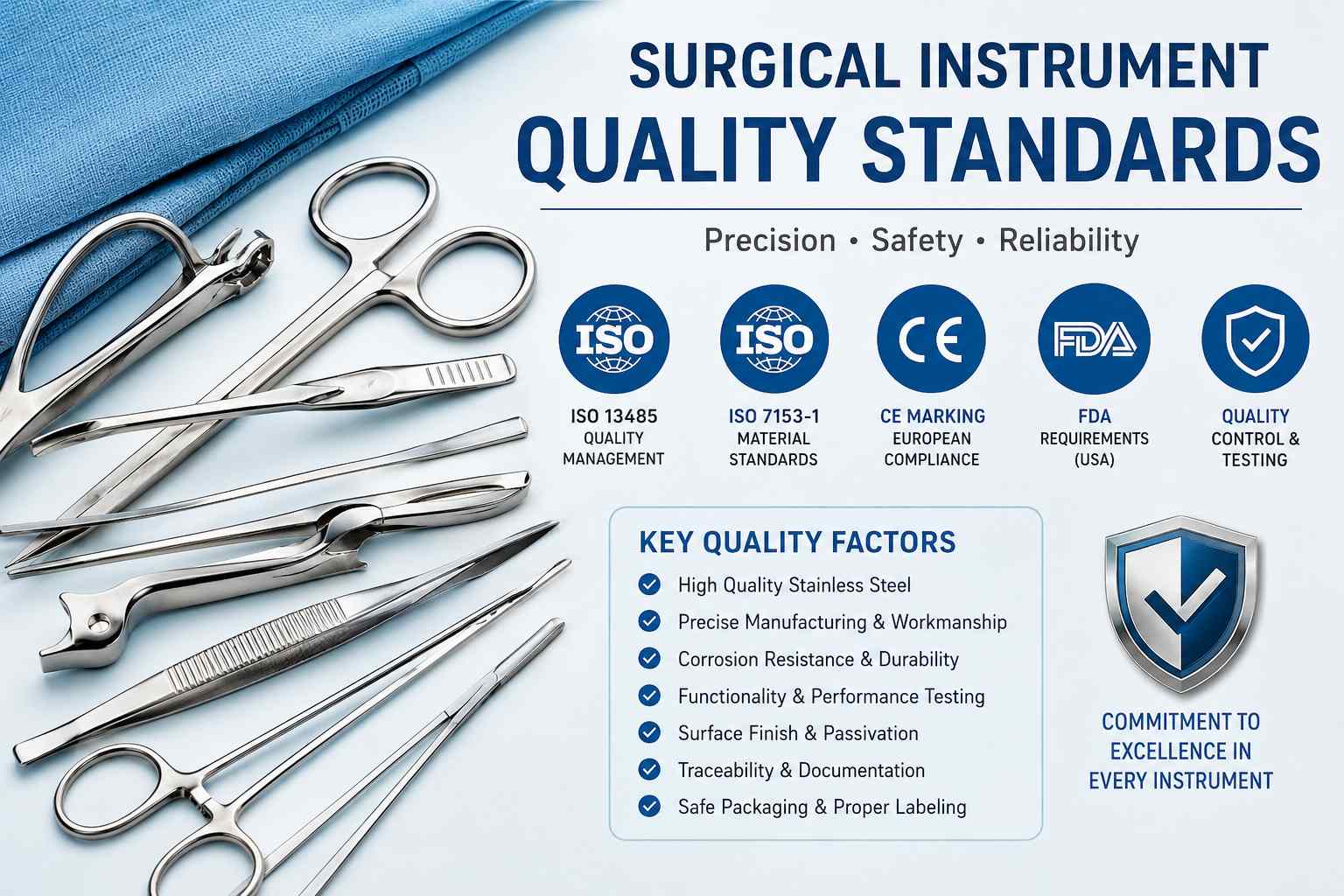
SEO Meta Title: Surgical Instrument Quality Standards: Complete Guide
Meta Description: Learn essential surgical instrument quality standards, including ISO 13485, ISO 7153-1, CE, FDA requirements, materials, testing, and quality control.
URL Slug: surgical-instrument-quality-standards
Primary Keyword: Surgical Instrument Quality Standards
Related Keywords: surgical instrument standards, surgical instrument quality control, ISO 13485 surgical instruments, ISO 7153-1, medical device quality standards, stainless steel surgical instruments, surgical instrument testing, surgical instrument manufacturing standards, reusable surgical instruments, surgical instrument inspection, medical instrument manufacturer, surgical instrument supplier
Surgical Instrument Quality Standards: A Complete Guide
Surgical instruments are essential tools used by healthcare professionals during medical and surgical procedures. From basic forceps and scissors to needle holders, retractors, clamps, and specialized orthopedic instruments, every product must perform reliably and safely.
For hospitals, distributors, importers, and medical device buyers, product appearance alone is not enough. Instruments should be manufactured from appropriate materials, accurately finished, properly tested, traceable, and produced under a controlled quality management system.
This is where Surgical Instrument Quality Standards become important.
Quality standards provide manufacturers and buyers with a framework for controlling materials, production processes, cleanliness, performance, documentation, packaging, and other critical characteristics. Depending on the instrument and destination market, manufacturers may need to comply with international standards as well as country-specific medical device regulations.
Understanding these requirements helps buyers select dependable suppliers and helps manufacturers establish consistent production systems.
Table of Contents
- What Are Surgical Instrument Quality Standards?
- Why Quality Standards Matter
- ISO 13485 Quality Management System
- ISO 7153-1 and Surgical Instrument Materials
- Stainless Steel Quality
- Manufacturing and Workmanship Standards
- Surface Finish and Passivation
- Functional and Performance Testing
- Corrosion Resistance
- Cleaning and Reprocessing Considerations
- Packaging and Labeling
- Traceability and Documentation
- CE and European Regulatory Requirements
- FDA Requirements for the U.S. Market
- Quality Control During Manufacturing
- How Buyers Can Evaluate a Manufacturer
- Frequently Asked Questions
- Conclusion
What Are Surgical Instrument Quality Standards?
Surgical Instrument Quality Standards are technical and regulatory requirements used to help ensure that surgical instruments are manufactured consistently and are suitable for their intended purpose.
They may cover areas such as:
- Raw material selection
- Stainless steel composition
- Manufacturing processes
- Dimensional accuracy
- Surface condition
- Corrosion resistance
- Hardness
- Functional performance
- Cleaning and contamination control
- Packaging and labeling
- Product identification
- Traceability
- Inspection and testing
- Quality management
- Risk management
Not every standard applies to every instrument. Requirements depend on whether the product is reusable or single-use, sterile or non-sterile, its intended purpose, device classification, material, and the country where it will be marketed.
For this reason, manufacturers should determine applicable standards and regulatory requirements for each product and target market.
Why Are Surgical Instrument Quality Standards Important?
A surgical instrument may look simple, but small manufacturing defects can significantly affect its performance.
For example, scissors with poorly aligned blades may not cut correctly. Forceps with mismatched tips may not grip tissue as intended. A needle holder with improperly fitted jaws may fail to hold a surgical needle securely.
Poor surface finishing can also create areas that are more difficult to clean or may contribute to staining and corrosion.
Effective quality controls help manufacturers maintain consistency from one production batch to another.
For buyers, quality standards provide a more objective way to evaluate suppliers. Instead of relying only on price or appearance, purchasers can examine manufacturing controls, certificates, test procedures, inspection records, material documentation, and product samples.
ISO 13485 and Surgical Instrument Manufacturing
One of the most important standards for medical device manufacturers is ISO 13485.
ISO 13485 specifies requirements for a quality management system where an organization needs to demonstrate its ability to provide medical devices and related services that consistently meet customer and applicable regulatory requirements.
For surgical instrument manufacturers, an ISO 13485-based quality management system may cover areas such as:
Supplier Control
Manufacturers should evaluate and control suppliers of raw materials, components, packaging, and outsourced processes according to their effect on product quality.
Production Control
Manufacturing operations should follow controlled procedures and defined specifications.
Inspection and Testing
Products should be inspected at appropriate stages of production to verify that specified requirements have been met.
Corrective and Preventive Processes
When problems occur, manufacturers need processes to investigate causes, take appropriate corrective action, and reduce the likelihood of recurrence.
Documentation
Quality records provide evidence that required manufacturing, inspection, and testing activities have been performed.
ISO 13485 certification can therefore be an important consideration when evaluating a surgical instrument manufacturer. However, buyers should also verify the certification’s scope, validity, and issuing certification body rather than relying only on a logo displayed on a website.
ISO 7153-1 and Metallic Materials
Material selection is fundamental to surgical instrument quality.
ISO 7153-1 addresses metallic materials used for various types of surgical instruments. It provides material-related information relevant to instrument manufacturing.
Different surgical instruments require different mechanical and corrosion-resistance properties. Therefore, manufacturers should choose materials appropriate for the intended instrument and its performance requirements.
Common materials used in surgical instrument production include different grades of stainless steel, depending on the application.
For example, an instrument requiring a hard cutting edge may have different material requirements from an instrument designed primarily for clamping or holding.
Material selection should therefore be based on engineering requirements rather than simply describing every instrument as “stainless steel.”
Stainless Steel Quality in Surgical Instruments
Stainless steel is widely used in reusable surgical instruments because it can provide a useful combination of strength, durability, corrosion resistance, and cleanability.
However, not all stainless steels have identical properties.
Commonly encountered stainless steel families in instrument manufacturing include martensitic and austenitic grades.
Martensitic stainless steels are frequently selected for instruments requiring hardness and wear resistance, while austenitic grades may be used for products where corrosion resistance and other mechanical characteristics are particularly important.
The appropriate grade depends on the design and intended function of the instrument.
Manufacturers should maintain material specifications and, where required, obtain material certificates or test reports to verify composition and properties.
Manufacturing and Workmanship Standards
High-quality raw material does not automatically produce a high-quality surgical instrument.
Manufacturing processes are equally important.
Depending on the instrument, production may involve forging, machining, milling, grinding, heat treatment, welding, assembly, polishing, passivation, cleaning, marking, and final inspection.
Each operation should be controlled.
Dimensional Accuracy
Critical dimensions should conform to approved drawings and specifications.
For forceps, this may include length, jaw dimensions, tip alignment, and serration geometry.
For scissors, blade geometry and alignment are particularly important.
Joint Quality
Box joints, screw joints, and other moving components should operate correctly without excessive looseness or undesirable resistance.
Jaw and Tip Alignment
The jaws or tips should meet as intended by the product design.
Misalignment may reduce gripping, dissecting, cutting, or holding performance.
Edges and Burrs
Unwanted sharp edges and manufacturing burrs should be removed unless an edge is intentionally part of the instrument’s functional design.
Careful workmanship is one of the clearest differences between a well-manufactured instrument and a low-quality alternative.
Surface Finish and Passivation
Surface quality is another major part of Surgical Instrument Quality Standards.
Surgical instruments may be supplied with different finishes, including polished, satin, or other specified surfaces. Regardless of appearance, the finish should be uniform and appropriate for the intended use.
Manufacturing operations can leave contaminants or free iron on stainless steel surfaces. Appropriate cleaning and passivation processes are commonly used to support corrosion resistance.
A controlled finishing process can help achieve:
- A uniform surface
- Reduced surface contamination
- Improved corrosion resistance
- Easier visual inspection
- Better overall product consistency
Manufacturers should define and validate or verify finishing processes as appropriate to the product and regulatory requirements.
Functional and Performance Testing
Visual inspection alone cannot confirm that an instrument will function correctly.
Functional testing should reflect the intended purpose of the device.
For example:
Surgical scissors may be evaluated for cutting performance, blade alignment, movement, and edge condition.
Needle holders may be checked for jaw alignment, gripping ability, ratchet operation, and joint movement.
Hemostatic forceps may require inspection of serrations, jaws, ratchets, and locking positions.
Tissue and dressing forceps should be checked for tip alignment, gripping surfaces, spring tension, and general finish.
Retractors may require dimensional, structural, and functional inspection based on their design.
Manufacturers should establish acceptance criteria rather than depending entirely on subjective visual judgment.
Corrosion Resistance
Reusable surgical instruments are exposed to demanding conditions during their service life. These may include water, detergents, disinfecting processes, sterilization cycles, handling, and storage.
Corrosion resistance is therefore an important quality characteristic.
Corrosion may be influenced by several factors, including:
- Incorrect stainless steel selection
- Improper heat treatment
- Poor surface finishing
- Inadequate passivation
- Chemical residues
- Exposure to inappropriate cleaning chemicals
- Improper storage or reprocessing
Manufacturers may use applicable corrosion-resistance test methods to evaluate materials and finished products.
Buyers should also remember that even well-manufactured reusable instruments require appropriate cleaning, sterilization, drying, handling, and maintenance.
Cleaning and Reprocessing Considerations
Reusable surgical instruments are generally designed to undergo repeated cleaning and sterilization according to validated healthcare procedures and the manufacturer’s instructions.
The design of an instrument should therefore consider its ability to be effectively cleaned and reprocessed.
Areas such as joints, hinges, serrations, channels, and textured surfaces deserve particular attention because contamination can be more difficult to remove from complex geometry.
Manufacturers of reusable medical devices should provide appropriate reprocessing information when required.
Clear instructions can address areas such as cleaning, disinfection, inspection, lubrication where applicable, sterilization, drying, and storage.
Packaging and Labeling Requirements
Quality control does not end after final polishing.
Surgical instruments must also be protected during storage and transportation.
Packaging should be appropriate for the product and should protect instruments against damage and contamination under expected distribution and storage conditions.
Labeling requirements vary depending on the product and destination market but may include information such as:
- Manufacturer identification
- Product name
- Catalog or reference number
- Lot or batch identification
- Device status where applicable
- Sterility information where applicable
- Relevant symbols
- Regulatory information
- Instructions or warnings where required
Manufacturers should use only regulatory marks and claims that legitimately apply to the product and market.
Traceability and Documentation
Traceability is an essential component of a professional medical device quality system.
A manufacturer should be able to connect relevant products with appropriate production and quality records according to applicable requirements.
Records may include:
- Raw material documentation
- Supplier information
- Batch or lot records
- Inspection reports
- Test results
- Production records
- Nonconformance records
- Calibration records
- Packaging information
- Complaint records
Effective traceability becomes particularly important if a defect or customer complaint is discovered after shipment.
Instead of treating the issue as an isolated problem, the manufacturer can investigate the relevant batch, manufacturing history, inspection results, and potentially affected products.
CE and European Regulatory Requirements
Companies supplying surgical instruments to the European Union need to consider the requirements of the EU Medical Device Regulation (MDR) 2017/745.
The exact regulatory pathway depends on device classification and other product characteristics.
Manufacturers may need to address areas including:
- Device classification
- Quality management
- Risk management
- Technical documentation
- Clinical evaluation
- Labeling
- Unique Device Identification where applicable
- Post-market surveillance
- Vigilance
- Declaration of conformity
- Conformity assessment
A CE mark should not be treated simply as a marketing logo. It represents conformity with applicable European regulatory requirements.
Importers and distributors should therefore verify relevant regulatory documentation rather than accepting unsupported CE claims.
FDA Requirements for Surgical Instruments
Surgical instruments marketed in the United States are regulated as medical devices by the U.S. Food and Drug Administration (FDA).
The specific requirements depend on the device classification, intended use, applicable regulation, and whether a premarket submission or exemption applies.
Manufacturers and exporters should correctly determine the regulatory status of each product.
Depending on the circumstances, requirements may involve establishment registration, device listing, labeling, quality system obligations, complaint handling, medical device reporting, and applicable premarket requirements.
Because regulatory requirements can change, manufacturers should verify the current FDA rules for the specific device before placing products on the U.S. market.
Quality Control During Surgical Instrument Manufacturing
An effective quality assurance program should operate throughout production rather than relying only on final inspection.
A typical quality-control workflow may include:
1. Incoming Material Inspection
Raw materials are checked against purchasing specifications and required documentation.
2. In-Process Inspection
Critical characteristics are inspected during machining, grinding, heat treatment, assembly, and other manufacturing stages.
3. Dimensional Inspection
Calipers, micrometers, gauges, and other appropriate measuring equipment may be used to verify dimensions.
4. Functional Testing
The instrument is evaluated according to defined functional requirements.
5. Surface Inspection
The product is checked for scratches, pits, cracks, unwanted sharp edges, polishing defects, and other surface problems.
6. Cleaning and Finishing Verification
Cleaning, polishing, and passivation processes are checked according to established procedures.
7. Final Inspection
The completed instrument is evaluated against approved specifications before release.
8. Packaging Inspection
Labels, product identification, packaging integrity, and quantities are verified before shipment.
This structured approach reduces the likelihood that defective instruments will reach customers.
How Buyers Can Evaluate a Surgical Instrument Manufacturer
Choosing a surgical instrument supplier should involve more than comparing quotations.
Hospitals, distributors, wholesalers, and importers should evaluate the manufacturer’s overall quality capabilities.
Important questions include:
- Does the manufacturer operate an appropriate quality management system?
- Is ISO 13485 certification available and valid?
- What materials are used for the requested instruments?
- Can material certificates be supplied when required?
- How are instruments inspected during production?
- What functional tests are performed?
- How are measuring instruments calibrated?
- How are nonconforming products controlled?
- Is batch or lot traceability maintained?
- Can samples be evaluated before a large order?
- What regulatory documentation is available for the destination market?
- Can the manufacturer support OEM specifications and private labeling?
A professional supplier should be able to discuss quality requirements technically rather than responding only with general statements such as “best quality.”
Quality Standards for OEM Surgical Instruments
OEM manufacturing creates additional quality-control responsibilities because the product may be manufactured according to customer-specific designs.
Before production begins, both parties should clearly define requirements such as:
- Instrument dimensions
- Stainless steel grade
- Surface finish
- Hardness where applicable
- Logo and marking
- Packaging
- Labeling
- Functional requirements
- Inspection criteria
- Documentation
- Applicable standards
- Regulatory responsibilities
Approved samples can be especially useful for OEM orders.
A documented specification reduces misunderstandings and provides measurable criteria for production and final inspection.
Frequently Asked Questions
What are the most important Surgical Instrument Quality Standards?
The applicable requirements depend on the instrument and market. ISO 13485 is widely used for medical device quality management systems, while standards such as ISO 7153-1 address metallic materials used for surgical instruments. Product-specific standards and national or regional regulations may also apply.
What is ISO 13485 for surgical instruments?
ISO 13485 is an international quality management system standard for organizations involved in medical devices. It covers areas including documentation, production controls, supplier management, traceability, corrective action, and other quality processes.
Which stainless steel is best for surgical instruments?
There is no single stainless steel grade that is best for every surgical instrument. Material selection depends on required hardness, strength, corrosion resistance, instrument design, and intended use.
Why is passivation important?
Passivation is commonly used as part of stainless steel finishing to help improve the condition of the surface and support corrosion resistance after manufacturing.
How can buyers check surgical instrument quality?
Buyers can review certification and regulatory documentation, inspect samples, confirm material specifications, examine workmanship, test instrument function, review traceability systems, and conduct supplier audits when appropriate.
Are all surgical instruments required to have CE marking?
CE marking requirements depend on whether the device is being placed on the EU market and on the applicable regulatory pathway. Manufacturers should determine the specific requirements under the EU MDR for their products.
Conclusion
Surgical Instrument Quality Standards are fundamental to producing reliable medical instruments. Quality begins with appropriate raw materials and continues through manufacturing, heat treatment, machining, finishing, cleaning, inspection, testing, documentation, packaging, and final release.
Standards such as ISO 13485 help manufacturers establish controlled quality management systems, while material and product-specific standards provide technical guidance for particular aspects of surgical instrument production. Manufacturers must also comply with the regulatory requirements of the markets in which their products are sold.