

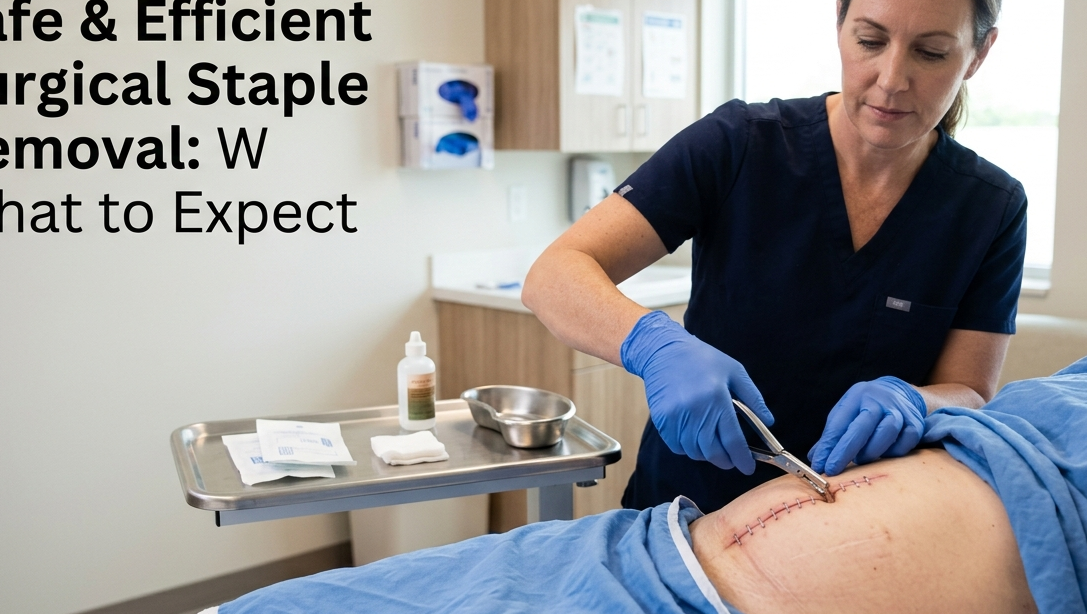
Meta Title: How Long Can Surgical Staples Stay In? Safe Removal Guide
Meta Description: Learn how long surgical staples can stay in, when they should be removed, what happens if they remain too long, and how to care for your wound safely.
Suggested URL Slug: /how-long-can-surgical-staples-stay-in/
A few years ago, someone close to me returned home after abdominal surgery with a long row of surgical staples. The hospital staff had explained the medicines, dressing changes, and activity restrictions, but one important detail was unclear: exactly when should the staples come out?
After about ten days, the incision looked much better. The pain had decreased, and there was no obvious bleeding. However, the follow-up appointment had been delayed. That created a new worry: how long can surgical staples stay in before they cause a problem?
This is a common situation. Patients sometimes miss their removal appointments because of transportation problems, busy clinics, unclear discharge instructions, or the mistaken belief that surgical staples will eventually fall out on their own.
In most cases, surgical staples are removed within 7 to 14 days. However, the exact removal time depends on the location of the wound, the type of surgery, the depth of the incision, and how quickly the patient is healing.
Surgical staples should not be removed at home. A doctor, nurse, or other trained healthcare professional should first examine the wound and decide whether it is strong enough to remain closed without them.
What Are Surgical Staples?
Surgical staples are small medical fasteners used to hold the edges of a wound or surgical incision together.
They may be used after:
- Abdominal operations
- Caesarean sections
- Knee or hip replacement
- Chest surgery
- Scalp injuries
- Orthopedic procedures
- Emergency treatment of deep cuts
- Some forms of cancer surgery
Staples are often chosen for long incisions because they can be placed quickly and provide strong, even support.
The staples visible on the skin usually hold the outer edges of the incision together. There may also be dissolvable stitches underneath the skin supporting deeper tissue.
Standard external surgical staples do not normally dissolve. They must be removed with a specially designed medical staple remover.
How Long Can Surgical Staples Stay In?
The usual removal period for surgical staples is approximately 7 to 14 days.
This does not mean that every patient should have their staples removed on the seventh, tenth, or fourteenth day. The correct timing depends on how well the wound is healing.
Some staples may be removed after 5 to 7 days, particularly in areas that heal quickly. Staples over joints or areas under greater tension may remain for 10 to 14 days. Certain wounds may require a longer period under medical supervision.
For example, staples or sutures after hip and knee replacement are often removed at around 10 to 14 days.
The safest answer is that surgical staples can stay in until the wound has developed enough strength to remain closed, but that decision should be made by a healthcare professional.
Surgical Staple Removal Time by Body Area
The following timeframes are general estimates. Your surgeon’s instructions should always take priority.
Scalp
Scalp staples are commonly removed within 7 to 14 days.
The scalp usually has a good blood supply, which may support faster healing. However, the size, depth, and cause of the wound can affect the removal date.
Hair, dried blood, and scabbing can make scalp staples appear worse than they actually are. Do not pull at the staples or pick away scabs to inspect them.
Face and Neck
Staples are used less frequently on highly visible facial areas because doctors often prefer closure methods that may leave less noticeable marks.
When staples are used near the face or neck, they may be removed earlier than those on the trunk or legs. Earlier removal reduces the chance of prominent staple marks, but it must only happen after medical assessment.
Chest
Staples following chest surgery are often removed within 7 to 14 days.
MedlinePlus provides this general timeframe in its discharge guidance for lung surgery.
Chest incisions may experience tension when a patient coughs, stretches, or pushes themselves up from a chair. Following activity restrictions is therefore important even when the wound looks closed.
Abdomen
Abdominal staples commonly stay in for 7 to 14 days, although some may remain longer if the wound is deep, under tension, or healing slowly.
A long abdominal incision does not always heal evenly. The upper section may look completely closed while a lower section remains swollen or moist.
In such situations, a healthcare professional may remove every second staple first and leave the others in place for a few additional days.
Arms and Legs
Staples on the arms or legs may remain for approximately 10 to 14 days.
Healing may take longer when the incision is near a joint, exposed to frequent movement, or affected by poor circulation.
Knees and Elbows
Wounds over joints frequently need more support because bending and straightening place repeated tension on the skin.
Staples around the knee or elbow may remain for 10 to 14 days, depending on the procedure and the surgeon’s instructions.
Feet and Lower Legs
Wounds on the feet and lower legs may heal more slowly, especially in people with diabetes, swelling, circulation problems, or reduced mobility.
Staples in these areas should be monitored carefully. Leaving them in longer may occasionally be necessary, but it should be a planned medical decision rather than an accidental delay.
What Determines How Long Staples Stay In?
Several factors influence the removal date.
1. Wound Location
Areas with a strong blood supply may heal faster. Areas that move constantly or carry body weight may require additional support.
A scalp wound, for example, may follow a different timeline from an incision over the knee.
2. Size and Depth of the Incision
Small, clean wounds may heal more quickly than long or deep surgical incisions.
The visible surface is only part of the healing process. Deeper layers may still be recovering even when the skin appears closed.
3. Type of Surgery
A planned surgical incision may heal differently from a wound caused by an accident or emergency operation.
The amount of tissue affected, the length of the operation, and the risk of contamination may all influence healing.
4. Infection
An infected incision may heal slowly or begin to separate.
Possible signs of infection include:
- Spreading redness
- Increasing warmth
- Worsening pain
- Swelling
- Pus or foul-smelling discharge
- Fever or chills
Staples should not simply be left in indefinitely because a wound is infected. The patient needs medical evaluation and appropriate treatment.
5. Diabetes
Diabetes can interfere with normal wound healing, particularly when blood sugar levels are poorly controlled.
Patients with diabetes may need closer wound monitoring and a carefully planned removal date.
6. Poor Circulation
Reduced blood flow means less oxygen and fewer nutrients reach the healing tissue.
This is particularly important for wounds on the lower legs and feet.
7. Smoking
Smoking can reduce oxygen delivery to tissues and slow the healing process.
Even occasional smoking during recovery may negatively affect the incision.
8. Certain Medications
Steroids, immune-suppressing medications, and some cancer treatments may delay wound healing.
Patients should make sure the surgeon knows about all prescription medicines, supplements, and ongoing treatments.
9. Physical Activity
Heavy lifting, stretching, bending, or returning to work too early can pull on the wound.
A patient may feel well enough to become active before the incision has regained adequate strength.
What Happens If Surgical Staples Stay In Too Long?
Keeping surgical staples in for one or two additional days does not automatically cause serious harm. However, leaving them in for several weeks without medical review can lead to problems.
Staples May Become Embedded
As the skin heals, tissue can begin growing around the staples.
Embedded staples may be more difficult and uncomfortable to remove. The clinician may need extra time to free them carefully without damaging the skin.
Removal May Become More Painful
Staple removal usually produces only a brief pinching or pulling sensation.
When staples remain in longer than necessary, dried material and new skin may build up around them, making removal more uncomfortable.
More Noticeable Marks May Develop
Surgical staples can leave small dot-like marks along both sides of an incision.
Leaving them in longer than required may make these marks more prominent.
Skin Irritation Can Occur
The skin surrounding individual staples may become red, itchy, sore, or inflamed.
A small amount of irritation does not always mean infection, but worsening redness or pain should not be ignored.
Infection May Go Unnoticed
Staples do not necessarily cause infection simply because they remain in a little longer.
The greater concern is that a missed follow-up appointment may allow drainage, wound separation, or infection to continue without professional assessment.
What Happens If Staples Are Removed Too Early?
Removing staples too early can be more dangerous than leaving them in for a small number of extra days.
If the incision has not developed enough strength, its edges may separate. This is called wound dehiscence.
Warning signs include:
- A gap appearing in the incision
- Fresh bleeding
- New fluid drainage
- A tearing or pulling sensation
- Increasing pain
- Deeper tissue becoming visible
This is why a healthcare professional examines the incision before removing the staples.
In some cases, alternate staples are removed first. If the wound remains closed, the remaining staples may then be removed. Adhesive support strips may also be placed across the incision.
Can Surgical Staples Stay In for Three Weeks?
Some surgical staples may remain for three weeks when a doctor believes the wound needs additional support.
However, three weeks is longer than the usual 7-to-14-day removal period. Staples that have been in place for this long should be assessed by a healthcare professional.
Do not wait simply because:
- The wound does not hurt
- The staples still look clean
- There is no bleeding
- The incision appears closed
Pain is not the only sign that staples need attention.
Can Surgical Staples Stay In for a Month?
Surgical staples should not remain in for a month unless a qualified healthcare professional has specifically recommended it.
After a month, there is a greater chance of:
- Skin growing around the staples
- Difficult removal
- Local irritation
- More visible staple marks
- An unrecognized wound complication
Contact the surgeon, wound clinic, hospital, or primary care provider as soon as possible. Do not attempt to remove them with household tools.
Never Remove Surgical Staples Yourself
Removing surgical staples at home is one of the most dangerous mistakes patients make.
Do not use:
- Pliers
- Tweezers
- Nail clippers
- Scissors
- Office staple removers
- Unapproved tools purchased online
A medical staple remover bends the center of the staple in a controlled way. This allows the ends to lift gently from the skin.
Pulling a staple straight upward can tear healing tissue, cause bleeding, introduce bacteria, or reopen the incision.
Medical aftercare guidance specifically advises patients not to remove staples themselves.
What to Do If You Miss Your Staple Removal Appointment
Missing your appointment does not mean you should panic.
Follow these steps.
Step 1: Check Your Discharge Papers
Look for information under headings such as:
- Wound review
- Staple removal
- Postoperative appointment
- Follow-up care
- Dressing clinic
- Practice nurse
The removal date may be listed separately from your main follow-up appointment.
Step 2: Calculate How Long the Staples Have Been In
Count from the day of surgery or the day the wound was stapled.
Write down:
- The date the staples were placed
- The recommended removal date
- The number of days they have been present
- Any changes in the wound
Step 3: Contact a Healthcare Provider
Call your surgeon’s office, hospital department, wound clinic, or primary care provider.
Explain:
- What surgery you had
- Where the staples are located
- How long they have been in
- Whether there is redness or drainage
- Whether your pain is improving or worsening
- Whether you have a fever
Step 4: Protect the Wound
Keep the area clean and avoid activities that pull on the incision.
Do not repeatedly press the wound to check whether it has healed.
Step 5: Arrange Professional Removal
Staples may be removed by a surgeon, trained nurse, wound-care professional, or primary care clinician, depending on local services.
How to Care for Surgical Staples
Correct wound care can reduce irritation and support healing.
Keep the Area Dry Initially
Many aftercare instructions recommend keeping the wound dry for the first 24 to 48 hours after staples are placed.
Follow your own surgeon’s instructions because recommendations may vary according to the operation and dressing.
Wash Gently
Once washing is permitted, gently clean around the wound with clean water and mild soap.
Do not scrub the staples. Pat the area dry with a clean towel.
Avoid Soaking
Do not soak the incision in a bathtub, hot tub, or swimming pool until your healthcare provider says it is safe.
Prolonged soaking can soften healing tissue and expose the wound to bacteria.
Change Dirty or Wet Dressings
Replace the dressing when instructed or whenever it becomes wet, dirty, or loose.
Wash your hands before and after touching the dressing.
Avoid Hydrogen Peroxide and Alcohol
Patients often use strong antiseptics because they believe a stinging product must be killing germs.
However, hydrogen peroxide and rubbing alcohol can irritate healing tissue and may slow recovery.
Only use wound-cleaning products recommended by your healthcare provider.
Prevent Clothing From Catching
Loose threads, rough towels, and tight clothing can catch on staples.
Wear comfortable clothing and move carefully when getting dressed.
Limit Physical Strain
Avoid lifting, exercise, stretching, or repetitive movement that pulls on the incision.
A simple practical rule is to stop an activity if it creates a pulling sensation along the staple line.
A Useful Daily Wound-Check Routine
Check the incision once each day in good lighting.
Focus on five things:
- Redness: Is it fading or spreading?
- Swelling: Is it decreasing or becoming worse?
- Drainage: Is the wound dry or producing new fluid?
- Pain: Is it gradually improving?
- Wound edges: Are they still together?
Taking one private photograph each day from the same distance can help you notice gradual changes.
A photograph should not replace medical advice, but it can help you explain changes to your healthcare provider.
When to Seek Medical Help
Contact a healthcare professional if you notice:
- Redness spreading away from the incision
- Increasing swelling or warmth
- Worsening pain
- Yellow, green, or foul-smelling drainage
- Fever or chills
- New bleeding
- A staple becoming deeply embedded
- Staples falling out early
- Separation of the wound edges
- A growing lump or fluid pocket under the skin
Seek urgent medical assistance if the wound opens widely, heavy bleeding develops, deeper tissue becomes visible, or you feel seriously unwell.
Final Takeaway
So, how long can surgical staples stay in?
For most patients, the usual removal period is 7 to 14 days. Staples after certain joint operations may remain for around 10 to 14 days, while some wounds may require a different timeline.
A short delay does not always create an emergency, but staples should not be forgotten for weeks. Leaving them in too long can cause embedding, irritation, more noticeable marks, and difficult removal. Removing them too early may allow the wound to reopen.