

SEO Meta Title: Surgical Instrument Maintenance: Complete Care Guide
Meta Description: Learn the best surgical instrument maintenance methods for cleaning, inspection, lubrication, sterilization, storage, and long-term instrument care.
URL Slug: surgical-instrument-maintenance
Focus Keyword: Surgical Instrument Maintenance
Surgical Instrument Maintenance
Surgical instruments play an important role in healthcare. Doctors use them for many medical and surgical procedures. Therefore, these instruments must remain clean, sharp, safe, and ready for use.
However, even a high-quality instrument can lose its performance over time. Poor cleaning can cause stains. Wrong storage can damage delicate tips. In addition, lack of lubrication can make joints stiff.
For these reasons, Surgical Instrument Maintenance is very important.
Proper maintenance helps instruments work smoothly. It can also increase their useful life. Moreover, regular inspection helps staff find damaged instruments before they are used.
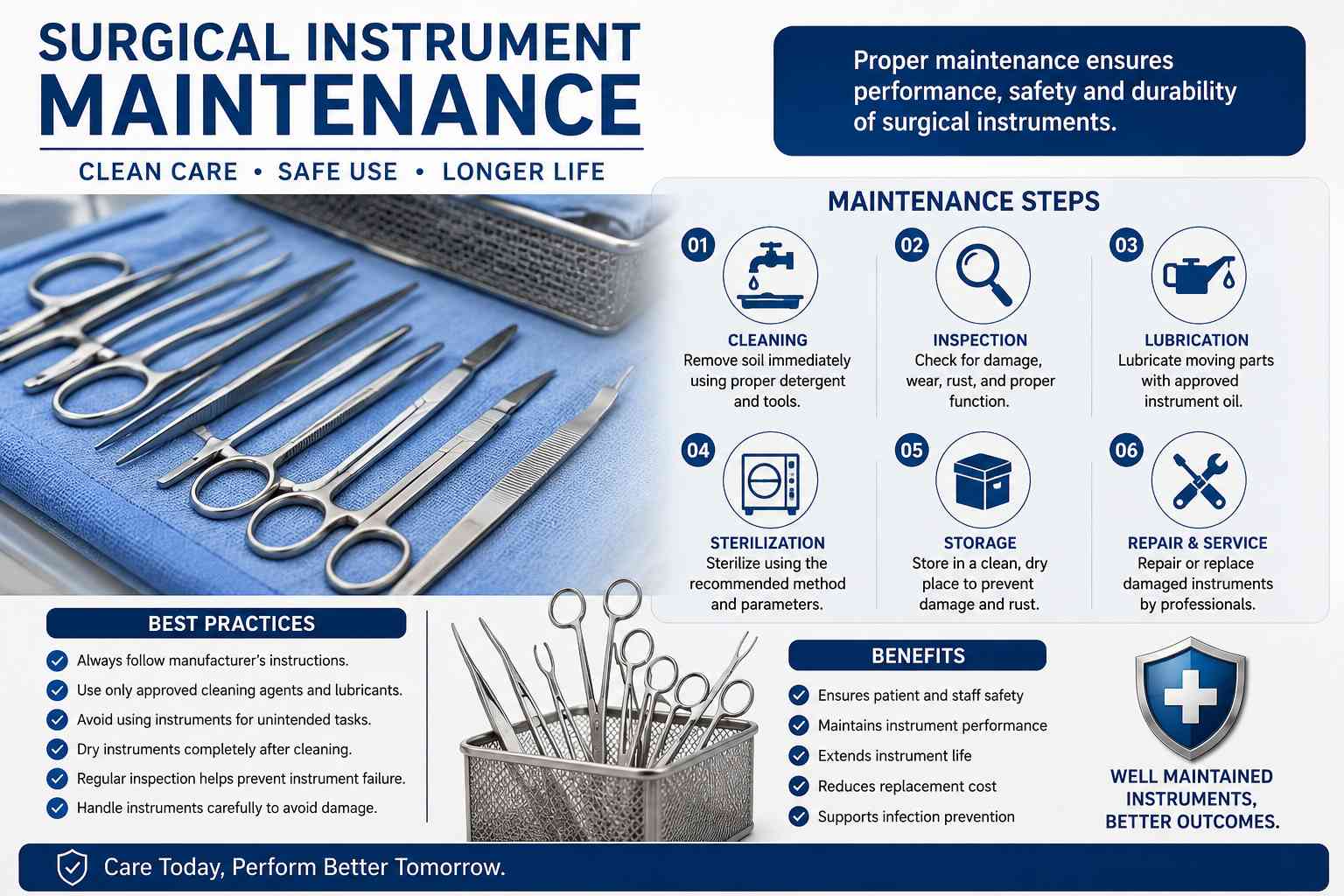
This guide explains how to clean, inspect, lubricate, sterilize, and store surgical instruments. It also covers common mistakes that can damage reusable instruments.
What Is Surgical Instrument Maintenance?
Surgical Instrument Maintenance means taking proper care of reusable surgical instruments. It includes several steps.
For example, instruments need cleaning after use. They also need careful inspection. Some instruments require lubrication as well.
In addition, damaged instruments may need repair or sharpening.
A complete maintenance process may include:
- Cleaning
- Rinsing
- Drying
- Inspection
- Functional testing
- Lubrication
- Sterilization
- Repair
- Sharpening
- Safe storage
However, every instrument is different. Therefore, healthcare staff should always follow the manufacturer’s instructions for use.
Why Is Surgical Instrument Maintenance Important?
Reusable surgical instruments can be expensive. As a result, hospitals need to protect them from unnecessary damage.
Good maintenance offers several benefits.
First, it helps instruments perform correctly. For example, well-maintained scissors can provide smooth cutting. Similarly, properly maintained forceps can grip as intended.
Second, regular care may increase the life of an instrument.
Third, inspection can help staff find problems early. A loose joint or damaged tip can then be repaired before the problem becomes worse.
Finally, proper care helps keep the instrument inventory in good condition.
Therefore, maintenance should be a regular part of instrument management.
Start Surgical Instrument Care After Use
Good instrument care starts soon after a procedure.
Blood and tissue can dry on instruments. Once this happens, cleaning may become more difficult. Therefore, used instruments should be handled according to the facility’s approved procedures.
At the same time, staff should protect delicate instruments from damage.
For example, heavy instruments should not be placed on top of fine scissors or forceps. Doing so may bend the tips or damage the joints.
Instruments should also be transported safely to the cleaning area.
Most importantly, healthcare workers should follow the manufacturer’s instructions during this process.
Cleaning Surgical Instruments
Cleaning is a key part of Surgical Instrument Maintenance.
Reusable instruments can collect blood, tissue, and other material during use. Therefore, they need proper cleaning before further processing.
The cleaning method depends on the instrument.
Some instruments may require manual cleaning. Others may be suitable for an automatic washer. In some cases, ultrasonic cleaning may also be recommended.
Always check the manufacturer’s instructions before choosing a cleaning method.
Use the Correct Cleaning Product
Do not use just any chemical on surgical instruments.
Instead, use a cleaning product that is suitable for the instrument. The product should also be used at the correct concentration.
Strong or unsuitable chemicals may damage instrument surfaces.
Therefore, follow both the instrument manufacturer’s and detergent manufacturer’s instructions.
Clean Difficult Areas Carefully
Some parts of an instrument are harder to clean.
These may include:
- Hinges
- Box locks
- Serrations
- Teeth
- Joints
- Grooves
- Channels
Pay special attention to these areas.
When required, hinged instruments should be opened during cleaning. This allows the cleaning process to reach hidden surfaces.
Manual Cleaning of Surgical Instruments
Some instruments need manual cleaning.
In this case, trained staff should use the correct cleaning solution and suitable brushes.
The cleaning solution should be prepared according to its instructions. In addition, staff should follow the correct water temperature and contact time.
Do not assume that more detergent means better cleaning. Too much detergent may leave residue.
Brushes also need careful selection.
A suitable brush can clean joints and serrations without damaging the surface. However, an unsuitable brush may scratch the instrument.
Therefore, always use cleaning tools that are designed for the task.
Ultrasonic Cleaning
Ultrasonic cleaners are commonly used for many compatible surgical instruments.
They use high-frequency sound waves to help remove soil from instrument surfaces and difficult areas.
This method can be useful for joints, serrations, and other detailed parts.
However, not every instrument can go into an ultrasonic cleaner.
For this reason, always check the manufacturer’s instructions first.
The ultrasonic cleaning machine also needs regular maintenance. Furthermore, staff should monitor its performance according to facility procedures.
Automated Cleaning
Many healthcare facilities use automated washers.
These machines can provide a controlled cleaning process. For example, they may control water temperature, cleaning time, detergent use, and rinsing.
As a result, automated cleaning can improve consistency.
However, instruments must be compatible with the selected cleaning cycle.
Staff should also load instruments correctly. Poor loading may reduce cleaning effectiveness.
Therefore, always follow the instructions for both the instruments and the cleaning equipment.
Rinse Instruments Properly
Rinsing is another important step.
Cleaning chemicals should not remain on an instrument after washing. Therefore, instruments need proper rinsing according to the approved cleaning process.
Water quality is also important.
Minerals in water may leave marks or deposits on stainless steel. In some cases, poor water quality may also affect the instrument surface.
For this reason, healthcare facilities should manage water quality according to their reprocessing requirements.
Dry Surgical Instruments Completely
After rinsing, instruments should be dried properly.
Water left on metal surfaces may cause stains. It can also increase the risk of corrosion.
Therefore, inspect instruments for remaining moisture.
Pay special attention to:
- Hinges
- Box locks
- Joints
- Grooves
- Channels
These areas can hold water.
Proper drying is a simple step. However, it can make a major difference in long-term instrument care.
Inspect Surgical Instruments After Cleaning
Inspection is one of the most important parts of Surgical Instrument Maintenance.
After cleaning, check each instrument carefully.
Look for:
- Cracks
- Stains
- Corrosion
- Pitting
- Bent tips
- Loose screws
- Damaged joints
- Dull blades
- Worn serrations
- Misaligned jaws
- Remaining contamination
Good lighting makes inspection easier.
In addition, magnification may help when checking small or delicate instruments.
If an instrument is damaged, remove it from normal use. It should then be repaired or replaced according to facility procedures.
Test the Function of Surgical Instruments
An instrument may look good but still have a functional problem.
Therefore, visual inspection alone is not always enough.
Functional testing helps confirm that the instrument works correctly.
Surgical Scissors
Check the blades and joint.
The scissors should move smoothly. They should also cut correctly.
If the scissors fold or tear the test material instead of cutting it, they may require servicing.
Needle Holders
Check the jaws, joint, and ratchet.
The jaws should meet correctly. In addition, the instrument should hold the needle as intended.
Hemostatic Forceps
Check the tips, serrations, box lock, and ratchet.
The instrument should open and close smoothly.
Tissue Forceps
Check the tips and teeth.
They should meet correctly according to the instrument design.
Rongeurs
Check the cutting jaws, springs, and joints.
Any damage or poor movement should be investigated before further use.
Lubricate Surgical Instruments When Required
Some surgical instruments contain moving parts.
For example, scissors, clamps, needle holders, and forceps have joints. These areas may require lubrication.
Proper lubrication can reduce friction. It can also help joints move smoothly.
However, use only a lubricant designed for medical instruments.
Do not use household oil or industrial oil.
The lubricant must also be suitable for the sterilization process.
Most importantly, follow the manufacturer’s instructions. Not every instrument requires the same type or amount of lubrication.
How to Prevent Surgical Instrument Corrosion
Stainless steel is widely used for surgical instruments. It offers good corrosion resistance.
However, stainless steel can still develop corrosion.
Several factors may cause problems.
For example, blood may remain on an instrument for too long. Strong chemicals can also affect the surface.
Other possible causes include:
- Poor rinsing
- Chlorides
- Moisture
- Wrong detergents
- Chemical residue
- Poor water quality
- Surface damage
- Improper storage
Therefore, clean and dry instruments carefully.
Also, inspect them regularly for rust-colored marks, pitting, or unusual stains.
If corrosion appears, remove the instrument from use and follow the correct evaluation process.
Avoid Harsh Chemicals
Using the wrong chemical is a common maintenance mistake.
Some chemicals can damage stainless steel. Others may cause discoloration or surface problems.
Therefore, never choose a cleaning chemical only because it is strong.
Instead, use products that are suitable for reusable surgical instruments.
Also, follow the correct dilution.
This approach protects both the instrument and the cleaning process.
Surgical Instrument Sharpening
Cutting instruments may become dull after repeated use.
Surgical scissors are a common example. Rongeurs, curettes, and other cutting instruments can also lose performance.
A dull instrument should not remain in normal use.
Instead, it should be evaluated for professional sharpening or repair.
Signs that an instrument may need service include:
- Poor cutting
- Dull edges
- Loose joints
- Bent tips
- Weak springs
- Misalignment
- Ratchet problems
Qualified technicians should perform repairs.
Poor sharpening can change the shape of an instrument. As a result, the instrument may no longer perform correctly.
Repair Damaged Surgical Instruments
Not every damaged instrument needs immediate replacement.
In some cases, professional repair can restore its function.
For example, technicians may be able to correct a loose joint or sharpen a cutting edge.
However, repairs should meet the required quality level.
Do not continue using an instrument simply because the damage looks small.
A minor defect can affect performance.
Therefore, damaged instruments should be separated from usable stock until they are properly evaluated.
Sterilization and Instrument Care
Sterilization is an important part of reusable surgical instrument processing.
However, cleaning must come first.
Sterilization does not replace cleaning.
Before sterilization, instruments should be cleaned, inspected, and prepared according to their instructions for use.
Many stainless steel surgical instruments can be processed with steam sterilization. However, this does not apply to every medical device.
Therefore, use the sterilization method specified for the instrument.
Correct sterilization protects the instrument and supports safe reprocessing.
Surgical Instrument Storage
Good Surgical Instrument Maintenance continues after sterilization.
Processed instruments need proper storage.
The storage area should protect them from moisture, contamination, and physical damage.
In addition, delicate instruments need extra care.
Heavy instruments should not crush fine instruments. Sharp tips should also be protected when appropriate.
Good organization can help staff find instruments quickly. It also makes it easier to notice missing or damaged items.
Maintenance of Surgical Scissors
Surgical scissors need regular inspection.
First, check the cutting edges. Next, inspect the joint and alignment.
The blades should move smoothly.
If the scissors become stiff, inspect the joint. Lubrication may be required if recommended by the manufacturer.
If cutting performance becomes poor, professional sharpening may be needed.
Do not continue using dull scissors.
Maintenance of Forceps
Forceps are available in many designs.
These include dressing forceps, tissue forceps, artery forceps, and other types.
During inspection, check the tips carefully.
Both sides should meet according to the design. Also, inspect teeth and serrations for damage.
Hinged forceps should open and close smoothly.
If the ratchet does not lock correctly, remove the instrument from service.
Maintenance of Needle Holders
Needle holders must grip surgical needles securely.
Therefore, inspect their jaws regularly.
Worn or damaged jaws may reduce grip.
Also, check the box lock and ratchet.
The instrument should move smoothly without excessive looseness.
Some needle holders contain tungsten carbide inserts. These may require special repair methods.
For this reason, use a qualified repair service when needed.
Maintenance of Retractors
Retractors may have simple or complex designs.
Fixed retractors mainly require careful cleaning and surface inspection.
Self-retaining retractors contain moving parts. Therefore, they need additional attention.
Check:
- Joints
- Screws
- Blades
- Ratchets
- Moving mechanisms
Make sure each part works correctly before the instrument returns to use.
Common Surgical Instrument Maintenance Mistakes
Simple mistakes can reduce the life of surgical instruments.
One common mistake is leaving blood and tissue on instruments for too long.
Another mistake is using unsuitable cleaning chemicals.
Other problems include:
- Poor drying
- Skipping inspection
- Incorrect lubrication
- Using damaged instruments
- Poor storage
- Mixing heavy and delicate instruments
- Ignoring dull cutting edges
- Using abrasive cleaning tools
- Incorrect sterilization
- Delaying repairs
Avoiding these mistakes can help protect instrument quality.
Create a Surgical Instrument Maintenance Program
Hospitals and surgical centers should have a clear maintenance program.
First, create standard procedures for cleaning and inspection.
Next, train staff to follow those procedures.
The program should also explain how to handle damaged instruments.
In addition, facilities can keep repair records. These records may show which instruments require frequent maintenance.
Regular inventory checks are also useful.
They help identify old, damaged, or missing instruments.
As a result, facilities can plan repairs and replacements before problems affect daily work.
Choose High-Quality Surgical Instruments
Good maintenance starts with good manufacturing.
A well-made instrument should use suitable materials. It should also have good workmanship and a proper surface finish.
Medical buyers should check several factors before choosing a supplier.
These include:
- Material quality
- Surface finish
- Tip alignment
- Joint quality
- Cutting performance
- Corrosion resistance
- Quality control
- Traceability
- Packaging
- Regulatory documentation
Price is important. However, the cheapest instrument may not always provide the best long-term value.
A durable instrument with proper maintenance may remain useful for a longer period.
Frequently Asked Questions
What is surgical instrument maintenance?
Surgical instrument maintenance includes cleaning, inspection, testing, lubrication, repair, sterilization, and proper storage. The goal is to keep reusable instruments in suitable working condition.
How often should surgical instruments be inspected?
Reusable instruments should be inspected as required during their reprocessing cycle. Additional maintenance may depend on use, instrument type, condition, and manufacturer instructions.
Can surgical instruments develop rust?
Yes. Stainless steel is corrosion resistant, but it is not completely rust-proof. Poor cleaning, moisture, chlorides, and unsuitable chemicals can contribute to corrosion.
Why should surgical instruments be lubricated?
Lubrication can help reduce friction in moving joints. However, only suitable medical instrument lubricants should be used when recommended.
Can surgical scissors be sharpened?
Yes. Many reusable surgical scissors can be professionally sharpened. However, sharpening should be done by qualified technicians.
What is the best way to store surgical instruments?
Store processed instruments in a clean and controlled area. Protect them from moisture, contamination, unnecessary handling, and physical damage.
Why do surgical instruments become stained?
Stains may come from minerals, chemical residue, poor rinsing, water quality, or corrosion. Therefore, the cause should be checked before the instrument returns to use.
Conclusion
Surgical Instrument Maintenance plays an important role in protecting reusable medical instruments.
Proper care starts soon after use. Instruments then need correct cleaning, rinsing, and drying.
After cleaning, staff should inspect every instrument. They should check joints, tips, cutting edges, serrations, and surfaces.
In addition, some instruments need lubrication. Others may require sharpening or professional repair.