

Table of Contents
- Introduction
- What is a Surgical Instruments Exporter?
- Why Hospitals Prefer Professional Surgical Instruments Exporters
- Types of Surgical Instruments Exported
- Manufacturing Process
- Quality Standards and Certifications
- Materials Used in Surgical Instruments
- Industries Served
- How to Choose the Right Surgical Instruments Exporter
- OEM & Private Label Manufacturing
- Global Export Markets
- Shipping & Packaging Standards
- Comparison Table
- Why Professional Enterprises is Your Reliable Export Partner
- Frequently Asked Questions
- Conclusion
Introduction
Choosing the right Surgical Instruments Exporter is one of the most important decisions for hospitals, distributors, importers, wholesalers, and medical equipment suppliers. Surgical instruments directly impact patient safety, surgical precision, and healthcare outcomes. Therefore, buyers need an exporter who consistently delivers premium-quality instruments that comply with international standards.
Pakistan, particularly Sialkot, has become one of the world’s leading manufacturing hubs for surgical instruments. With decades of craftsmanship, advanced manufacturing technology, and internationally recognized quality standards, surgical instrument exporters from Pakistan serve healthcare providers in more than 140 countries.
Whether you’re looking for general surgery instruments, dental instruments, orthopedic tools, ENT instruments, or customized surgical kits, working with an experienced exporter ensures consistent quality, competitive pricing, and timely delivery.
This comprehensive guide explains everything buyers need to know before selecting a reliable surgical instruments exporter.
What is a Surgical Instruments Exporter?
A Surgical Instruments Exporter is a company that manufactures or sources medical instruments and supplies them to international healthcare markets.
These exporters provide products to:
- Hospitals
- Medical distributors
- Healthcare procurement companies
- Government organizations
- NGOs
- Private clinics
- Medical universities
- Importers
- Wholesalers
Professional exporters manage every aspect of international trade, including manufacturing, quality inspection, documentation, packaging, customs clearance, and global shipping.
Why Hospitals Prefer Professional Surgical Instruments Exporters
Healthcare professionals cannot compromise on quality. A trusted exporter offers several advantages.
Superior Product Quality
Premium stainless steel instruments maintain sharpness, durability, and corrosion resistance for years.
Competitive Pricing
Direct manufacturers eliminate unnecessary middlemen, allowing buyers to receive factory-direct prices.
Consistent Manufacturing
Reliable exporters maintain consistent dimensions, finishes, and performance across every production batch.
International Certifications
Leading exporters manufacture products according to international regulatory requirements.
Worldwide Shipping
Experienced exporters handle logistics efficiently for air, sea, and courier shipments.
Types of Surgical Instruments Exported
Professional surgical instrument exporters offer thousands of products covering nearly every medical specialty.
General Surgery Instruments
- Scissors
- Forceps
- Needle Holders
- Retractors
- Clamps
- Hemostats
- Speculums
Dental Instruments
- Extraction Forceps
- Elevators
- Mirrors
- Probes
- Scalers
- Bone Rongeurs
Orthopedic Instruments
- Bone Chisels
- Bone Files
- Osteotomes
- Bone Holding Forceps
- Reduction Forceps
Neurosurgery Instruments
- Kerrison Rongeurs
- Curettes
- Dissectors
- Micro Forceps
Gynecology Instruments
- Uterine Forceps
- Dilators
- Vaginal Speculums
- Curettes
ENT Instruments
- Nasal Forceps
- Ear Instruments
- Laryngeal Instruments
- Sinus Surgery Instruments
Ophthalmic Instruments
- Eye Scissors
- Corneal Forceps
- Needle Holders
- Micro Surgical Instruments
Manufacturing Process
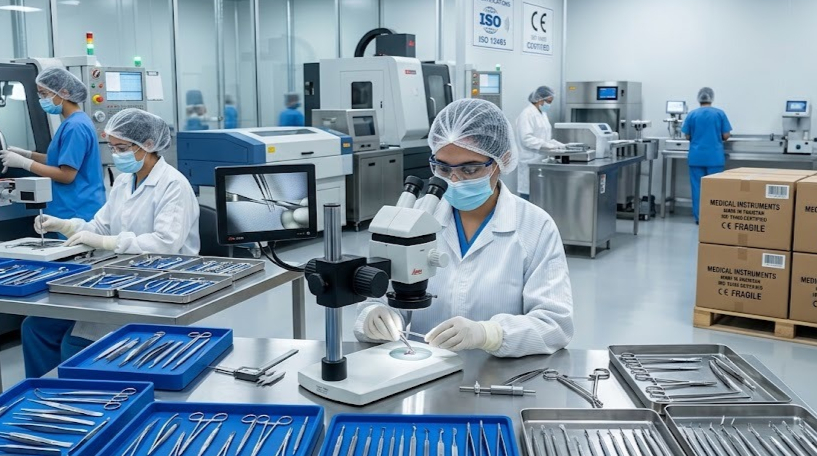
A professional Surgical Instruments Exporter follows a strict manufacturing process.
1. Raw Material Selection
Only premium-grade German or Japanese stainless steel is selected for manufacturing.
2. Forging
Steel is heated and forged into the required instrument shape.
3. Machining
CNC machines ensure precise dimensions and smooth finishing.
4. Heat Treatment
Controlled heat treatment improves hardness and durability.
5. Grinding
Every instrument is carefully shaped and sharpened.
6. Polishing
Multiple polishing stages create a satin or mirror finish.
7. Assembly
Jointed instruments are assembled using precision rivets or screws.
8. Ultrasonic Cleaning
Products are thoroughly cleaned to remove manufacturing residues.
9. Quality Inspection
Each instrument undergoes visual, dimensional, and functional testing.
10. Packaging
Products are individually packed according to customer specifications.
Quality Standards and Certifications
Reliable exporters maintain internationally recognized quality systems.
Common certifications include:
- ISO 13485
- CE Marking
- FDA Registration (where applicable)
- GMP Compliance
- Quality Management Systems
Quality inspections typically include:
- Surface finish inspection
- Hardness testing
- Corrosion resistance testing
- Joint movement testing
- Sharpness testing
- Functional inspection
- Dimensional accuracy
Materials Used in Surgical Instruments
Material quality determines an instrument’s lifespan and performance.
Common materials include:
Stainless Steel
The most widely used material because of its corrosion resistance and durability.
German Stainless Steel
Preferred for premium surgical instruments due to excellent hardness and precision.
Japanese Stainless Steel
Known for superior sharpness and edge retention.
Tungsten Carbide
Used in needle holders and scissors for enhanced cutting performance and longer service life.
Titanium
Lightweight, corrosion-resistant, and MRI-compatible for specialized surgical applications.
Industries Served
Professional exporters supply products to various sectors.
- Government hospitals
- Private hospitals
- Medical distributors
- Medical wholesalers
- Universities
- Surgical training institutes
- Humanitarian organizations
- Military hospitals
- Veterinary clinics
How to Choose the Right Surgical Instruments Exporter
Selecting the right supplier can significantly impact your business.
Experience
Choose companies with years of manufacturing and export expertise.
Certifications
Verify international certifications and quality management systems.
Product Range
A comprehensive catalog simplifies procurement.
Custom Manufacturing
Ensure the exporter offers OEM and private-label solutions.
Quality Control
Request inspection reports and quality assurance documentation.
Customer Support
Responsive communication reflects professionalism and reliability.
Delivery Performance
Timely shipments help maintain inventory and customer satisfaction.
OEM & Private Label Manufacturing
Many distributors build their own brands through OEM manufacturing.
Services often include:
- Custom logo engraving
- Private labeling
- Customized packaging
- Product catalog development
- Barcode labeling
- Laser marking
- Customized instrument sets
OEM manufacturing helps distributors establish a unique market identity while benefiting from expert manufacturing capabilities.
Global Export Markets
Leading Surgical Instruments Exporters serve customers across the globe.
Major export destinations include:
- United States
- Canada
- Germany
- United Kingdom
- France
- Italy
- Spain
- Australia
- Saudi Arabia
- UAE
- Qatar
- South Africa
- Brazil
- Malaysia
- Singapore
Global demand continues to grow due to increasing healthcare investments and expanding surgical services.
Shipping & Packaging Standards
Professional exporters understand the importance of safe transportation.
Packaging solutions include:
- Individual poly bags
- Blister packs
- Sterile packaging
- Custom printed boxes
- Export cartons
- Palletized shipments
Shipping methods:
- Air Freight
- Sea Freight
- DHL
- FedEx
- UPS
- TNT
Complete export documentation generally includes:
- Commercial Invoice
- Packing List
- Certificate of Origin
- Bill of Lading
- Air Waybill
- Inspection Certificate (if required)
Comparison Table
| Feature | Professional Exporter | Ordinary Supplier |
|---|---|---|
| International Certifications | ✔ | Limited |
| Quality Inspection | ✔ | Basic |
| OEM Services | ✔ | Rare |
| Global Shipping | ✔ | Limited |
| Bulk Manufacturing | ✔ | Moderate |
| Technical Support | ✔ | Basic |
| Custom Packaging | ✔ | Limited |
| Export Documentation | ✔ | Partial |
Why Professional Enterprises is Your Reliable Export Partner
At Professional Enterprises, we understand the evolving needs of global healthcare providers and medical distributors. As a trusted Surgical Instruments Exporter, we focus on delivering precision-crafted instruments that meet international quality standards.
Our strengths include:
- Premium stainless steel instruments
- Strict quality control procedures
- OEM & ODM manufacturing
- Private label services
- Competitive factory pricing
- Worldwide shipping
- Experienced export team
- Timely production schedules
- Customized packaging solutions
- Long-term business partnerships
Whether you are a distributor, wholesaler, importer, or hospital procurement team, we are committed to delivering reliable products and exceptional customer service.
Frequently Asked Questions
What does a Surgical Instruments Exporter do?
A surgical instruments exporter manufactures or supplies medical instruments and ships them internationally while managing quality control, documentation, and logistics.
Which countries import surgical instruments?
Major importing countries include the USA, Germany, UK, Canada, Australia, UAE, Saudi Arabia, France, Italy, and many others.
Why is Sialkot famous for surgical instruments?
Sialkot has over a century of experience in manufacturing precision surgical instruments and is recognized worldwide for skilled craftsmanship and high-quality production.
Can exporters provide customized branding?
Yes. Most professional exporters offer OEM manufacturing, laser logo engraving, custom packaging, and private labeling.
What certifications should I look for?
Look for ISO 13485 certification, CE compliance, GMP standards, and other relevant regulatory approvals depending on your target market.
What is the typical production lead time?
Lead times usually range from 2 to 8 weeks, depending on order size, customization requirements, and product availability.
Conclusion
Selecting the right Surgical Instruments Exporter is essential for ensuring product quality, regulatory compliance, and long-term business success. A trusted exporter offers precision manufacturing, international certifications, reliable logistics, and exceptional customer support.