

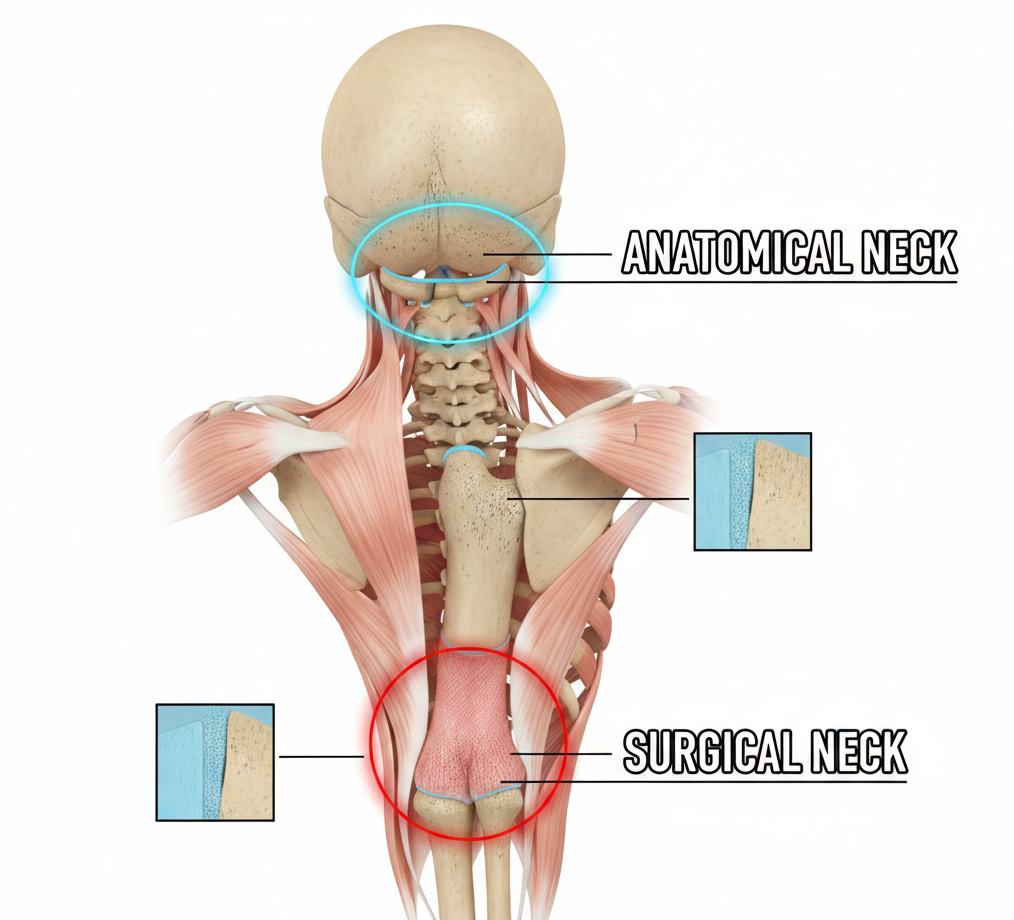
Introduction
The anatomical and surgical neck of humerus are two important structural landmarks located in the upper arm bone. These regions play a crucial role in shoulder movement, joint stability, and clinical diagnosis—especially in orthopedic, radiological, and surgical fields. Understanding these necks of the humerus is essential for medical students, physiotherapists, surgeons, radiologists, and anyone studying the musculoskeletal system.
The humerus is the longest and strongest bone of the upper limb, connecting the shoulder to the elbow. At its proximal end, the humerus forms a ball-and-socket joint with the scapula, enabling a wide range of arm movements. This proximal portion is also where both the anatomical neck and surgical neck are located—each having different structural features, functions, and clinical implications.
In this comprehensive guide, we explore the detailed anatomy of the humerus necks, their differences, functions, common injuries, fracture patterns, blood supply, nerve relations, and clinical significance.
Understanding the Anatomy of the Humerus
Before diving into the types of humerus necks, it is important to understand the proximal humerus anatomy. The upper end consists of:
- Head of humerus – articulates with the glenoid cavity of the scapula
- Anatomical neck – the narrow groove surrounding the head
- Greater and lesser tubercles – attachment points for major shoulder muscles
- Intertubercular sulcus (bicipital groove)
- Surgical neck – the narrowed region below the tubercles
- Shaft of humerus
The humerus is vital for performing movements such as abduction, rotation, lifting, pushing, and pulling—making its structural integrity essential for upper limb function.
Anatomical Neck of Humerus
What is the Anatomical Neck?
The anatomical neck of the humerus is a narrow groove that lies just below the head of the humerus. It represents the former epiphyseal (growth) plate in adults and distinguishes the smooth articular surface of the head from the tubercles.
Location
- Directly below the humeral head
- Above the greater and lesser tubercles
- Forms the boundary of the articular capsule attachment
Structure and Appearance
- A slight constriction
- Oblique angle to the shaft
- Smooth but clearly visible line
- Site of capsular attachment
Function
The anatomical neck:
- Serves as an attachment point for the shoulder joint capsule
- Separates the head from surrounding tubercles
- Contributes to shoulder stability
- Plays a role in the humeral head’s blood supply
Importance of the Anatomical Neck
Joint Capsule Attachment
The shoulder capsule attaches tightly at the anatomical neck, helping stabilize the glenohumeral joint.
Blood Supply
Branches of the anterior and posterior circumflex humeral arteries supply this region.
Damage here may compromise the humeral head blood supply, increasing the risk of avascular necrosis (AVN).
Rare Fracture Site
Although fractures can occur here, anatomical neck fractures are rare and usually caused by high-energy trauma.
Surgical Neck of Humerus
What is the Surgical Neck?
The surgical neck of humerus is the narrow area located below the tubercles where the bone transitions into the shaft. It is called the “surgical” neck because fractures commonly occur here, often requiring surgical intervention.
Location
- Just distal to the greater and lesser tubercles
- Above the humeral shaft
- Near the axilla (armpit region)
Structure
- A thinner and weaker part of the humerus
- More prone to fractures
- Surrounded by neurovascular structures
Function
Although not a major attachment point, it plays a vital role in:
- Load distribution from shoulder to arm
- Upper limb biomechanics
Importance of the Surgical Neck
Most Common Fracture Location
Surgical neck fractures are among the most common humeral fractures, especially in:
- Elderly patients with osteoporosis
- Individuals who fall on an outstretched hand (FOOSH injury)
Nerve and Vessel Relations
The axillary nerve and posterior circumflex humeral artery run close to the surgical neck.
Fractures here may cause:
- Loss of shoulder abduction
- Deltoid muscle weakness
- Sensory loss over the “regimental badge area”
Surgical Significance
Many surgical procedures involve this area due to:
- Common fracture patterns
- Accessibility
- Proximity to brachial plexus branches
Differences Between Anatomical and Surgical Neck of Humerus
Understanding the differences is essential for clinical practice.
| Feature | Anatomical Neck | Surgical Neck |
|---|---|---|
| Location | Directly below humeral head | Below tubercles, above shaft |
| Clinical Importance | Capsule attachment, blood supply | Common fracture site |
| Fracture Risk | Rare | Very common |
| Associated Risk | Avascular necrosis | Axillary nerve damage |
| Function | Joint stability | Structural transition point |
| Appearance | Slight groove | Narrowed bone area |
| Surgical Interest | Less commonly involved | Frequently operated |
Both structures are equally important but serve different roles in anatomy and medicine.
Blood Supply of Proximal Humerus and Clinical Relevance
The head and neck regions are supplied by:
- Anterior circumflex humeral artery
- Posterior circumflex humeral artery
- Arcade of vessels around anatomical neck
Damage to these vessels—especially during anatomical neck fractures—may lead to:
- Avascular necrosis
- Delayed healing
- Joint dysfunction
Surgical neck fractures rarely compromise humeral head blood supply but may injure surrounding neurovascular structures.
Nerve Relations of the Humerus Necks
The most clinically important nerve is the axillary nerve, which:
- Passes through the quadrangular space
- Wraps around the surgical neck
- Supplies the deltoid and teres minor muscles
Injury Signs:
- Weakness in shoulder abduction
- Atrophy of deltoid muscle
- Loss of sensation on the lateral shoulder (badges area)
This makes surgical neck fractures particularly important in emergency medicine and orthopedics.
Common Injuries to the Anatomical and Surgical Neck
1. Anatomical Neck Fractures
Although rare, they occur due to:
- High-energy trauma
- Direct blows
- Violent shoulder dislocation
- Sports injuries
These fractures are dangerous because they can disrupt the humeral head’s blood supply, increasing the risk of AVN.
Surgical Neck Fractures
These are far more common and typically occur from:
- Low-energy falls (especially in older adults)
- Falls on an outstretched hand
- Motor vehicle accidents
- Osteoporosis-related fragility
Types of Surgical Neck Fractures
- Impacted fractures
- Angulated fractures
- Displaced fractures
- Comminuted fractures
Treatment depends on the fracture pattern and may include:
- Immobilization
- Physical therapy
- ORIF (Open Reduction and Internal Fixation)
- Hemiarthroplasty in severe cases
Clinical Examination and Diagnosis
Physical Examination
Doctors check:
- Pain localization
- Arm movement limitation
- Swelling and bruising
- Neurovascular compromise (important for surgical neck fractures)
Imaging Techniques
X-ray
First-line imaging to assess fractures.
CT Scan
Helps evaluate complex fracture patterns.
MRI
Used to assess:
- Soft tissue damage
- Blood supply compromise
- Associated rotator cuff injuries
Treatment of Humerus Neck Fractures
Non-Surgical Treatment
Used for non-displaced fractures:
- Sling immobilization
- Physiotherapy
- Pain management
Surgical Treatment
Indicated for:
- Displaced fractures
- Angulated fractures
- Nerve involvement
- Multi-part fractures
Surgical techniques include:
- Plate and screw fixation
- Intramedullary nailing
- Joint replacement in severe cases
Biomechanics of the Humerus Necks
The anatomical neck:
- Supports rotational movements
- Provides joint stability
The surgical neck:
- Transfers forces from shoulder muscles to the shaft
- Handles torsional stress during lifting, pushing, and rotation
Understanding these biomechanics helps in designing surgical implants and rehabilitation programs.
Rehabilitation After Humerus Neck Injuries
Rehabilitation focuses on:
Restoring Range of Motion
Gentle exercises after pain reduces.
Strengthening Muscles
Deltoid, rotator cuff, and scapular muscles.
Preventing Stiffness
Early movement (under guidance) is crucial.
Avoiding Re-Injury
Load must be increased gradually.
Recovery may take:
- 4–6 weeks for simple fractures
- 3–6 months for severe fractures
- Up to 1 year for full functional recovery
Conclusion
The anatomical and surgical neck of humerus are two essential structural components that play major roles in shoulder stability, movement, and clinical diagnosis. While the anatomical neck is important for joint capsule attachment and blood supply, the surgical neck is more clinically significant due to its vulnerability to fractures and its close relationship with the axillary nerve.