

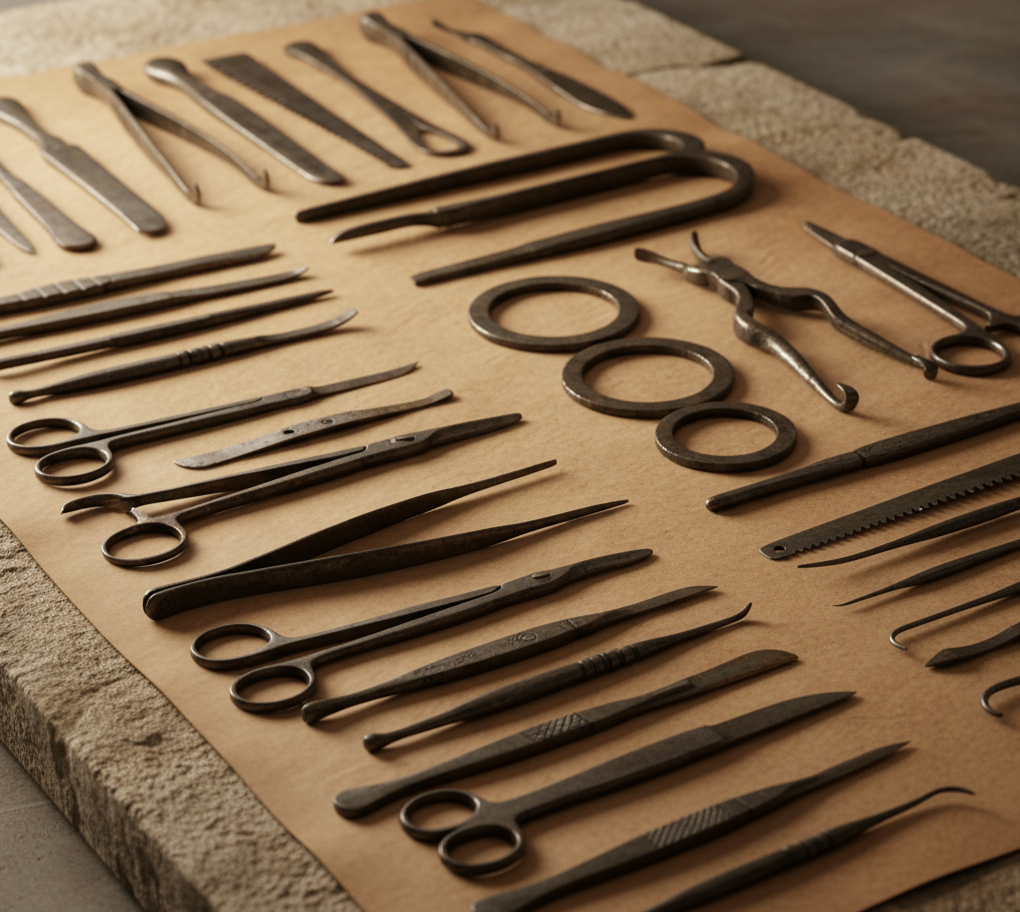
Keyword Focus: ancient surgical instruments
Word Count: ~1700 words
For thousands of years, surgery has been an essential part of medical care. Long before modern hospitals, anesthesia, and steel instruments existed, ancient civilizations developed tools to treat injuries, perform operations, and save lives. These ancient surgical instruments were often crafted from bronze, iron, obsidian, or other natural materials, and many of them became the foundation for the surgical tools we use today.
This detailed, SEO-optimized article explores the history, types, and importance of ancient surgical instruments, showing how early medical innovations shaped the future of surgery.
Introduction: The Roots of Surgical Tools
Ancient civilizations such as Egypt, Greece, Rome, India, China, and the Islamic Golden Age contributed immensely to early surgical knowledge. Their instruments—ranging from scalpels to forceps—were surprisingly advanced for their time.
These tools tell us:
- How early doctors understood the human body
- How they approached healing and disease
- The level of craftsmanship and innovation in ancient societies
Many ancient surgical instruments resemble the modern versions used today, proving that surgical creativity has deep roots in human history.
The Earliest Evidence of Surgical Instruments
The earliest surgical instruments date back over 5,000 years, and archaeological discoveries have revealed the sophistication of ancient medicine.
Civilizations known for advanced surgical tools:
- Ancient Egypt
- Ancient Greece
- Roman Empire
- Ancient India (Ayurveda)
- Ancient China
- Islamic Golden Age
- Medieval Europe
Each civilization contributed unique tools, techniques, and medical philosophies.
Ancient Egyptian Surgical Instruments
The Egyptians practiced medicine with a blend of science and spirituality. Their surgical instruments were among the earliest documented in history.
Common Egyptian Surgical Tools:
Bronze Scalpels
Used for incisions and minor surgeries. Many featured curved blades.
Forceps
For extracting splinters, removing tissue, and assisting with wound care.
Needle and Thread
Used to stitch wounds—often with linen thread.
Cautery Instruments
Heated metal rods used to stop bleeding and treat infections.
Trephination Tools
Used for drilling holes in the skull to treat head injuries.
Egyptian surgical kits discovered in tombs show a surprising level of craftsmanship, proving that ancient surgeons were skilled practitioners.
Ancient Greek Surgical Instruments
Greek physicians advanced medical science through observation, experimentation, and documentation.
Famous Greek doctors using ancient surgical instruments:
- Hippocrates
- Herophilus
- Galen (later practiced in Rome)
Important Greek Surgical Instruments:
Scalpels (Machaira)
Straight or curved blades made of bronze or iron.
Bone Levers
Used for realigning fractures.
Vaginal Speculum
Early versions designed for gynecological examinations.
Catheters
Developed to treat urinary blockages.
Cautery Knives
Used extensively by Hippocratic physicians.
Greek surgical tools helped develop rational, systematic medicine.
Roman Surgical Instruments
The Romans improved upon Greek medicine, developing highly advanced surgical tools used in military and civilian settings.
Common Roman Surgical Instruments:
Scalpel and Lancets
Used for incisions, bloodletting, and tumor removal.
Forceps and Hooks
For extracting arrows, bone fragments, and teeth.
Bone Saws
Used in amputations and orthopedic procedures.
Vaginal Speculum (Spoon of Diocles)
One of the most iconic Roman instruments.
Dilators
Used for opening narrow passageways.
Bronze Needles
Straight and curved for suturing.
Many Roman instruments discovered at archaeological sites resemble modern stainless-steel tools. Their precision shows the skill of Roman instrument makers.
4. Ancient Indian Surgical Instruments (Ayurveda)
Indian surgeon Sushruta is considered the “Father of Surgery.” His text, the Sushruta Samhita, describes more than 120 surgical instruments, many still used today.
Major Indian Ancient Surgical Instruments:
Mandalagra Scalpel
For circular incisions.
Arrow Remover
A specialized tool used in battlefield injuries.
Hooks (Vidalaka)
For lifting tissues.
Forceps (Sandansha)
For grasping and removing foreign bodies.
Bone Saw
Used in fractures and amputations.
Needles
Of varying sizes for suturing.
India’s contributions to plastic surgery, especially rhinoplasty, also relied on advanced surgical tools crafted from iron.
Ancient Chinese Surgical Instruments
Traditional Chinese medicine focused on balance and energy, but also used physical tools for surgery.
Key Chinese Surgical Tools:
Stone or Bronze Knives
Used in early surgical procedures.
Needles
For acupuncture and minor surgical manipulations.
Hooked Tools
Used to remove blockages or foreign bodies.
Cautery Instruments
Used with herbal medicines to reduce infection.
Chinese physicians also pioneered early anesthesia using herbal mixtures.
Islamic Golden Age Surgical Instruments
Between the 8th and 14th centuries, Islamic medicine advanced rapidly, thanks to scholars like Al Zahrawi, who documented 200+ instruments.
Important Islamic Surgical Instruments:
Cautery Tools
Used for various internal and external diseases.
Lithotomy Forceps
Designed to remove bladder stones.
Eye Surgery Instruments
Like the hollow needle for cataract treatment.
Dental Tools
Including extraction forceps and scrapers.
Obstetric Instruments
For childbirth assistance.
The surgical illustrations of this era influenced European medicine for hundreds of years.
Medieval European Surgical Instruments
During the Middle Ages, European surgery improved slowly and was heavily influenced by Islamic medical texts.
Common Medieval Surgical Instruments:
Trephines
For skull surgery.
Bone Levers and Saws
Designed for battlefield injuries.
Surgical Knives
Used for amputations and abscess drainage.
Leeches and Lancets
For bloodletting.
Tooth Extractors
Like the pelican and dental keys.
While many tools were primitive, they laid the groundwork for Renaissance surgical innovations.
Materials Used to Make Ancient Surgical Instruments
Different civilizations used materials based on what was available and durable:
Common materials included:
- Bronze
- Iron
- Gold
- Obsidian (volcanic glass)
- Bone
- Wood
- Brass
Interestingly, obsidian blades were sharper than today’s steel and are still used in some specialized surgeries.
How Ancient Surgical Instruments Influenced Modern Tools
Many modern instruments have direct ancestors in ancient medicine.
Examples:
- Forceps → Used since Egypt and Rome
- Speculum → Originated in Greece and Rome
- Scalpels → Used by nearly every early civilization
- Suturing needles → Found in all ancient surgical kits
- Bone saws → Perfected by Romans and Indians
Even many plastic surgery tools originated from ancient Indian practices.
Why Studying Ancient Surgical Instruments Matters Today
Understanding ancient surgical instruments offers important insights:
How early doctors solved medical problems
The evolution of human craftsmanship
The foundation of modern medical engineering
How surgery progressed over thousands of years
The cultural significance of medical innovation
This knowledge benefits historians, medical students, researchers, and anyone interested in how surgery evolved.
Conclusion: The Legacy of Ancient Surgical Instruments
The history of ancient surgical instruments reveals an incredible story of human innovation, courage, and intelligence. From Egyptian bronze scalpels to Roman forceps, from Indian rhinoplasty tools to Al Zahrawi’s advanced surgical kit, ancient civilizations shaped the surgical world we know today.
Despite limited technology, early surgeons developed precise, effective tools that laid the foundation for modern surgical techniques. The influence of these ancient instruments continues in hospitals, medical schools, and surgical research.
Understanding them is not only a journey into medical history—it is a reminder of the remarkable human desire to heal, innovate, and advance medicine for future generations.