

Introduction
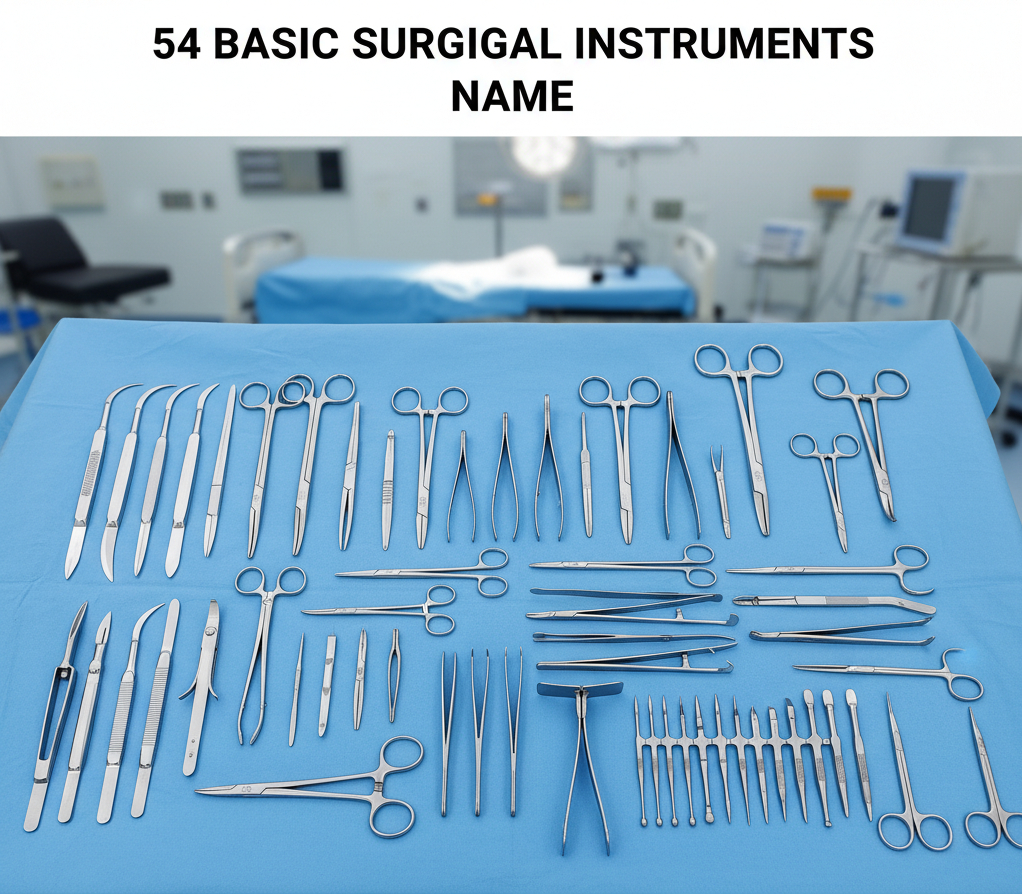
In every surgical procedure — whether minor or major — surgical instruments play a vital role. They are the tools that allow surgeons to make precise incisions, control bleeding, hold tissues, and close wounds effectively. For medical students, surgical technologists, and healthcare professionals, learning the 54 basic surgical instruments name list is a foundation for understanding the world of surgery.
Each instrument is designed for a specific function, and recognizing them by name, shape, and use helps ensure safety and efficiency in the operating room. In this article, we’ll go through the names, functions, and categories of 54 essential surgical instruments that are commonly used in general surgery — all explained in detail with proper SEO structure.
What Are Surgical Instruments?
Surgical instruments are specially designed tools or devices used by surgeons and medical staff to perform surgical procedures. They are typically made of high-grade stainless steel, which allows sterilization, precision, and durability.
Every instrument has a purpose — cutting, clamping, retracting, dissecting, or suturing. Understanding the names and functions helps medical teams work seamlessly in the sterile field.
Categories of Basic Surgical Instruments
Before listing the 54 names, it’s important to understand how instruments are grouped. Most surgical tools fall into one of the following categories:
- Cutting and Dissecting Instruments
– Used to cut tissue, bone, or sutures. - Grasping and Holding Instruments
– Used to hold tissues, organs, or surgical materials. - Clamping and Occluding Instruments
– Used to stop blood flow or secure tissue. - Retracting and Exposing Instruments
– Used to hold back tissues for better visibility. - Suturing and Stapling Instruments
– Used for closing wounds. - Suctioning and Aspirating Instruments
– Used to remove fluids from the surgical site. - Dilating and Probing Instruments
– Used to explore or widen openings.
Now, let’s move on to the 54 basic surgical instruments name list with uses.
54 Basic Surgical Instruments Name and Their Uses
Cutting and Dissecting Instruments
- Scalpel Handle No. 3 – Used with blades for precise incisions in soft tissue.
- Scalpel Handle No. 4 – Larger handle used for deeper incisions.
- Scalpel Blade No. 10 – Commonly used for large skin incisions.
- Scalpel Blade No. 11 – Used for stab incisions or drainage procedures.
- Scalpel Blade No. 15 – Ideal for short, precise cuts.
- Metzenbaum Scissors – Used to cut delicate soft tissue.
- Mayo Scissors (Straight) – Used to cut sutures and materials.
- Mayo Scissors (Curved) – Used to cut heavy tissue or fascia.
- Iris Scissors – Small scissors used for fine cutting in delicate surgeries.
- Tenotomy Scissors – Used for precise cutting of tendons and tissues.
- Lister Bandage Scissors – Designed for cutting dressings and bandages.
- Wire Cutting Scissors – Used for cutting surgical wire or pins.
Grasping and Holding Instruments
- Tissue Forceps (Adson) – Used to grasp delicate tissues.
- Toothed Adson Forceps – Provides firm grip for skin closure.
- Dressing Forceps – Used to handle dressings or non-tissue materials.
- Debakey Forceps – Used in vascular surgery to hold blood vessels.
- Russian Tissue Forceps – Used for grasping dense tissue.
- Allis Tissue Forceps – Used to hold or grasp heavy tissue.
- Babcock Forceps – Used for holding delicate structures like intestines.
- Kocher Forceps – Used for grasping tough tissue or fascia.
- Foerster Sponge Forceps – Used to hold gauze or sponges during cleaning.
- Magill Forceps – Used in airway management to guide tubes.
Clamping and Occluding Instruments
- Mosquito Hemostatic Forceps – Used to clamp small blood vessels.
- Kelly Hemostatic Forceps – Used to control bleeding in medium vessels.
- Crile Hemostatic Forceps – All-purpose clamp for small to medium vessels.
- Rochester-Pean Forceps – Used for larger tissue and vessel clamping.
- Rochester-Carmalt Forceps – Used to clamp tissues before cutting.
- Right Angle Clamp (Mixter) – Used to reach vessels around structures.
- Satinsky Clamp – Used in cardiovascular surgery to partially occlude vessels.
- Bulldog Clamp – Small vascular clamp for delicate procedures.
- Doyen Intestinal Clamp – Used for clamping bowel tissue without crushing.
Retracting and Exposing Instruments
- Senn Retractor – Double-ended retractor used in small incisions.
- Army-Navy Retractor – Used to retract shallow or superficial incisions.
- Weitlaner Retractor – Self-retaining retractor for deeper exposure.
- Gelpi Retractor – Self-retaining retractor with pointed tips.
- Richardson Retractor – Used in deep abdominal or chest incisions.
- Deaver Retractor – Curved retractor used for abdominal exposure.
- Balfour Retractor – Large self-retaining retractor used in abdominal surgery.
- Bookwalter Retractor – Used in major abdominal and pelvic surgeries.
- Langenbeck Retractor – Handheld retractor used in general surgery.
Suturing and Stapling Instruments
- Needle Holder (Mayo-Hegar) – Used to hold needles during suturing.
- Crile-Wood Needle Holder – Provides precision in delicate suturing.
- Castroviejo Needle Holder – Used in microsurgery and ophthalmic procedures.
- Skin Stapler – Used to close skin incisions quickly.
- Staple Remover – Used for removing surgical staples safely.
Suctioning and Aspirating Instruments
- Yankauer Suction Tip – Used to remove fluids in oral and general surgery.
- Poole Suction Tip – Used to suction fluids in abdominal or large wounds.
- Frazier Suction Tip – Used for precise suction in neurosurgery or ENT.
Dilating and Probing Instruments
- Uterine Sound – Used to measure the depth of the uterus.
- Male Urethral Sound – Used to dilate the male urethra.
- Female Urethral Dilator – Used to dilate the female urethra.
- Grooved Director with Probe – Used to guide scalpels during incisions.
- Lacrimal Probe – Used to open or dilate the tear duct.
- Vaginal Speculum (Cusco’s or Graves) – Used to open the vaginal canal for examination or procedures.
Bonus Tip: How to Memorize Surgical Instrument Names Easily
Remembering 54 surgical instrument names can be challenging for beginners. Here are a few study strategies:
- Group by Function: Learn them category by category (cutting, holding, etc.).
- Use Flashcards: Include instrument images, names, and functions.
- Practice in Labs: Handling real or demo instruments reinforces memory.
- Create Mnemonics: For example, “Mayo Makes Muscle Cuts” (Mayo scissors = muscle).
- Visual Learning: Study labeled diagrams or tray setups.
You can also create digital flashcards or download printable study sheets with images for each instrument.
Care and Maintenance of Surgical Instruments
Every surgical instrument must be properly cleaned, inspected, and sterilized after use to prevent infection and damage. Here’s how professionals ensure longevity and safety:
1. Cleaning
- Rinse instruments immediately after use to remove blood or tissue.
- Use enzymatic detergents for manual cleaning.
- Employ ultrasonic cleaners for thorough decontamination.
2. Inspection
- Check for sharpness, alignment, and damage.
- Ensure joints move smoothly without resistance.
3. Lubrication
- Apply approved surgical lubricants on hinged instruments to prevent rusting.
4. Sterilization
- Use autoclave (steam sterilization) or low-temperature methods depending on material.
5. Storage
- Keep instruments organized in sterile trays.
- Separate delicate tools from heavy ones to prevent damage.
Importance of Knowing the 54 Basic Surgical Instruments
Understanding these 54 basic surgical instruments name and their uses offers several benefits for medical students, nurses, and surgical staff:
- Enhances surgical preparation and efficiency.
- Reduces instrument mix-ups during operations.
- Helps in assembling surgical trays accurately.
- Builds confidence during clinical training or exams.
- Ensures better communication within the surgical team.
For companies like Professional Enterprises, providing instrument education alongside high-quality products builds trust among clients and professionals alike.
Conclusion
Knowing the 54 basic surgical instruments name and their uses is essential for anyone entering the medical or surgical field. These instruments — from scalpels and scissors to retractors and clamps — are the foundation of every surgical procedure.
Whether you’re a student learning anatomy, a surgical technologist preparing trays, or a manufacturer supplying medical tools, mastering these instrument names enhances safety, precision, and professionalism.
Each tool has a story and a purpose — together, they make modern surgery possible.